Why is Continuous Ventilation or Dehumidification Needed in Industrial Drying? Decoding & Optimizing the Process
06/01/2026
Decoding the Classic Engineering Question
If you are a kiln operator or a thermal engineering student, you have likely encountered the question: "Why is continuous ventilation or dehumidification needed in industrial drying?".
The theoretically correct answer is: To reduce the water vapor pressure of the air environment surrounding the material, allowing water in the material to evaporate more easily.
However, in actual production, choosing between "Ventilation" (exhausting hot air) or "Dehumidification" (recovering heat) will determine the profitability of the business. This article will analyze these two methods in depth.
1. Physics Principle: Why Must Water Vapor Be Removed?
Drying is essentially the process of transferring water from the liquid phase (inside the material) to the vapor phase (into the air). Water always moves from an area of high pressure (wet material) to an area of low pressure (dry air).
If the air in the drying chamber becomes saturated (Humidity reaches 100%), it cannot hold any more water vapor. At this point, no matter how much you increase the temperature, the drying process will stop, potentially "steaming" the product, causing discoloration and structural damage. Therefore, continuous removal of water vapor is mandatory.
2. Method 1: Forced Ventilation (Open Loop)
This is the traditional method used in wood-fired, coal-fired, or old electric resistance kilns.
How it works: Fans exhaust the hot, humid air inside the kiln directly outside, while simultaneously drawing in fresh (cold) air from the outside to be heated up from scratch.
Disadvantages: Causes massive energy waste because you are throwing away the heat you paid to generate. Additionally, this method is entirely dependent on the weather (ineffective when it rains or during high humidity seasons).
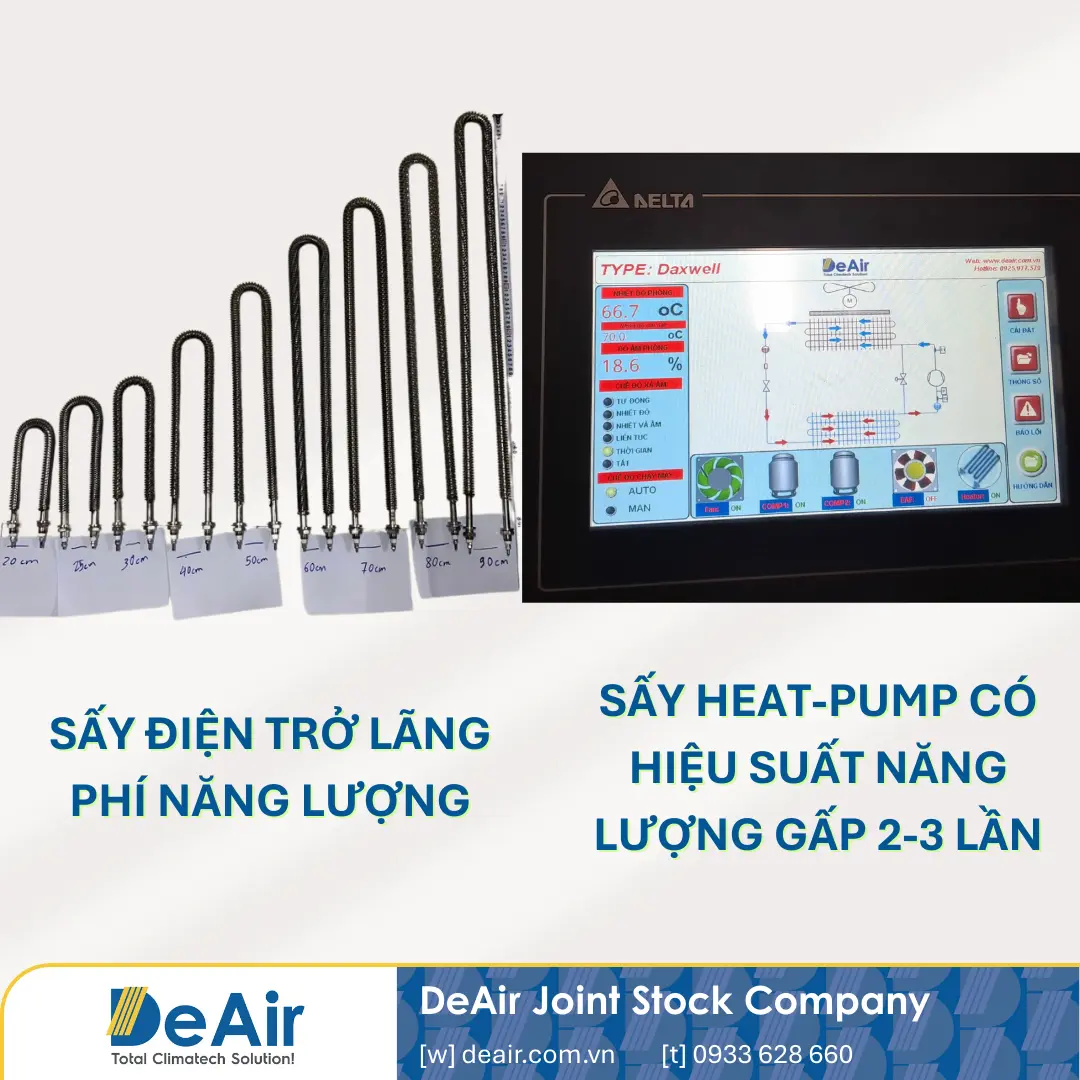
Diagram showing Heat-pump drying recovers heat, saving superior energy compared to resistance ventilation drying.
How it works: Instead of exhausting hot air outside, the Heat Pump dryer keeps that air stream within a closed chamber. Water vapor is condensed by the cold coil into liquid water and drained out through a pipe. The heat released from the condensation process is recovered to reheat the dry air stream.
Advantages: Saves 50-70% of electrical energy. Preserves the product's original flavor and color due to drying at low temperatures in a clean environment (no dust).
Why does closed-loop drying (no outside ventilation) still dry the product?
Because water is not vented out as vapor into the sky, but is condensed by the Heat Pump dryer into liquid water at the cold coil and drains out into the sewer. The dry air after water separation continues the cycle to dry the product.
Does continuous dehumidification cause loss of aroma in agricultural products (tea, herbs)?
If using the Ventilation method (exhausting air out), the aroma will blow away with the wind. But using the Cold Drying/Heat Pump method (closed loop), all the valuable aromas and essential oils are retained intact within the drying chamber, helping to increase the commercial value.
How does material thickness affect the moisture release process?
The thicker the material, the longer it takes for water to move from the center to the surface. At this time, no matter how powerful the external dehumidifier is, waiting time is needed. Therefore, an intermittent drying mode (tempering) is required to save electricity. Learn more at: The Effect of Thickness on the Drying Process.
Switch to Energy-Saving Drying Technology Now!
Are you using an energy-wasting ventilation dryer? Contact DeAir for effective Heat-pump heat recovery solutions.


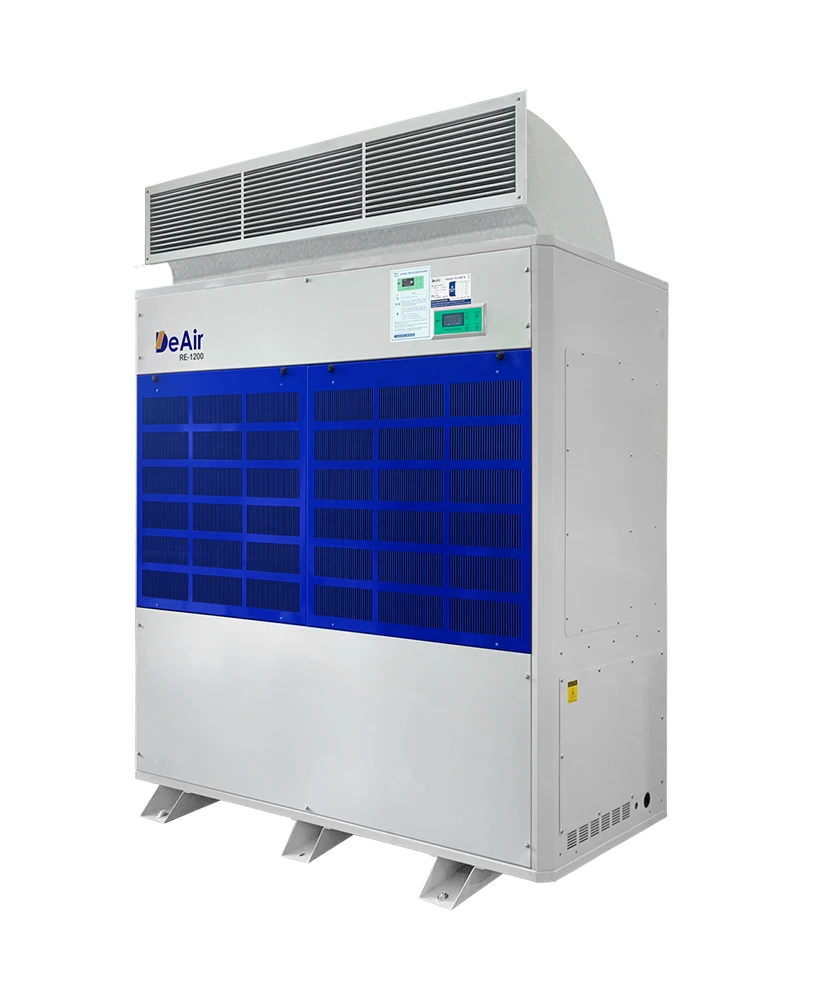 DeAir.RE
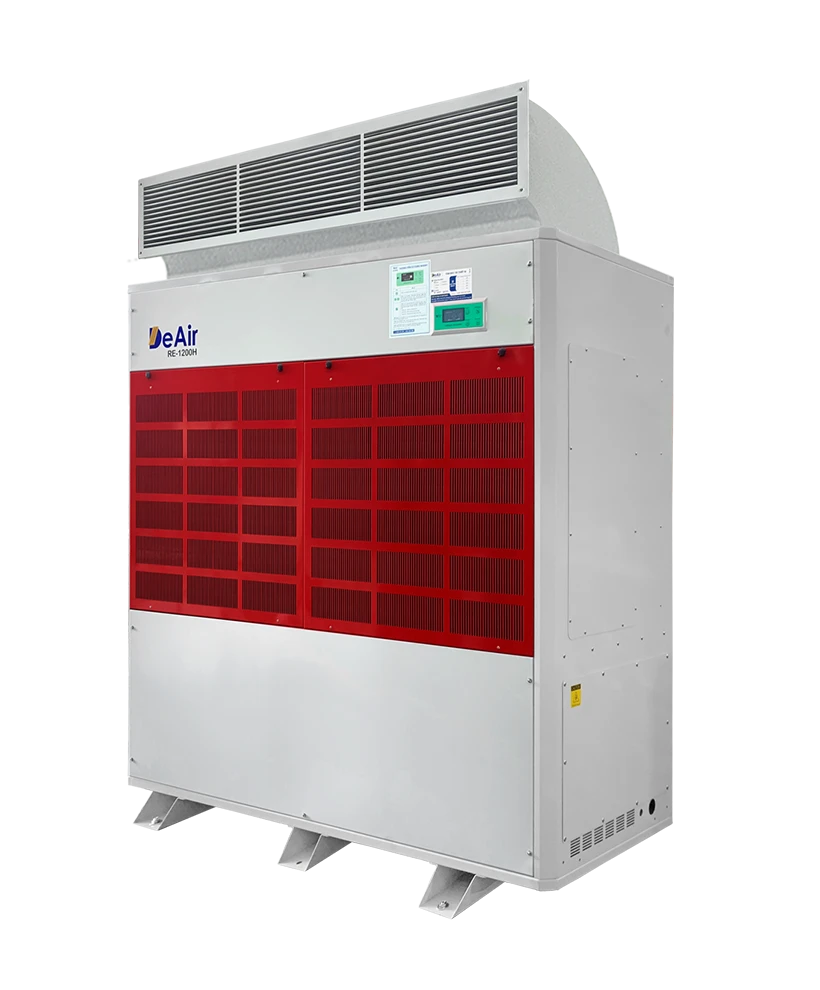 DeAir.RE-H
 DeAir.RE-INOX
 DeAir.CRE
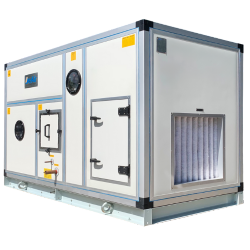 Dezenno
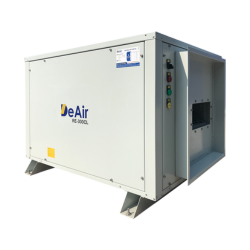 DeAir.RE-CL
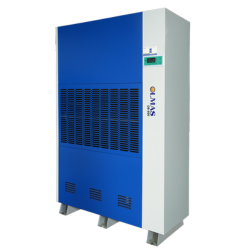 Olmas-OS
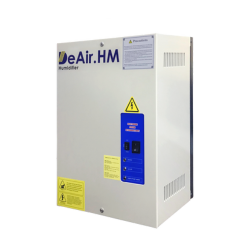 DeAir.HM
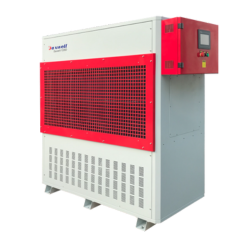 Daxwell
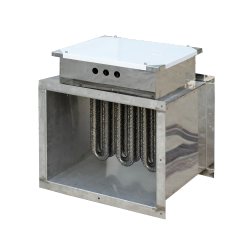 DeAir.Heat
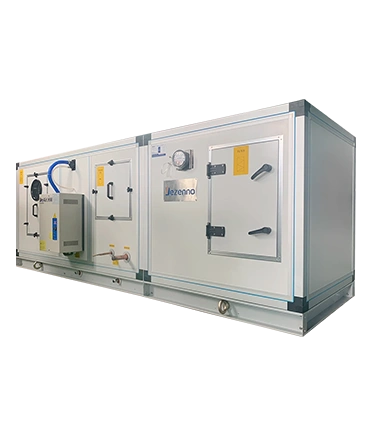 AHU
AHU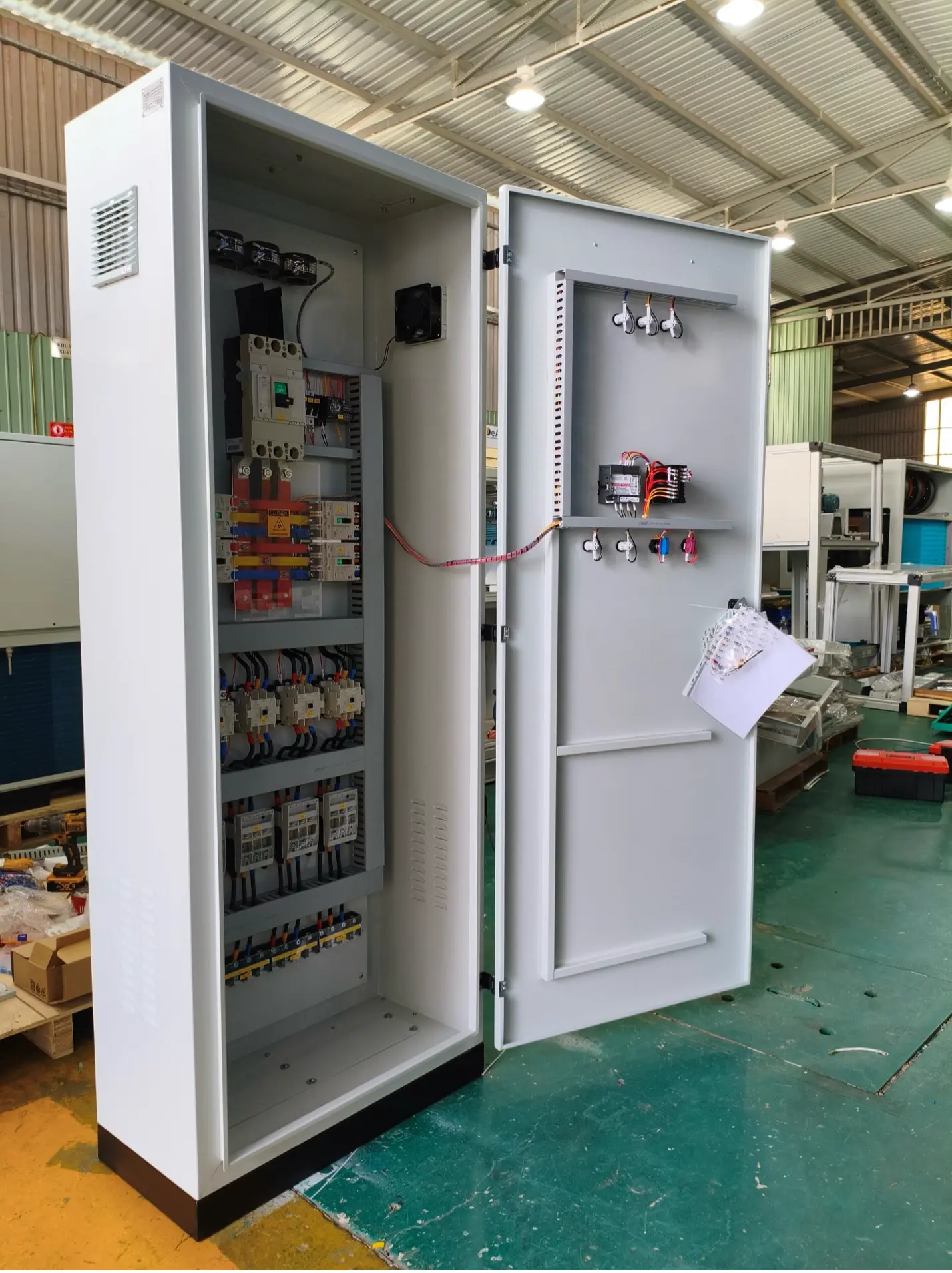






![[Case Study] DeAir Installs DeAir.De Rotor Humidity Control System for Pharmaceutical Plant in Binh Duong](https://deair.com.vn/thumbs/news/2023_04/ban_giao_may_cho_duoc_bd/[270x153-cr]image1-1024x772.jpg__cv.webp "[Case Study] DeAir Installs DeAir.De Rotor Humidity Control System for Pharmaceutical Plant in Binh Duong")

![[Review & Guide] Olmas OS-300: The New Humidity Control "Warrior" for Medium to Large Warehouses](https://deair.com.vn/thumbs/news/huong_dan_su_dung_may_olmas_21/[270x153-cr]vtm06440.png "[Review & Guide] Olmas OS-300: The New Humidity Control \"Warrior\" for Medium to Large Warehouses")