Preservative-Free Fresh Produce Trends: How Microclimate Engineering Rescues Post-Harvest Agriculture
05/06/2026
Preservative-Free Fresh Produce Trends: How Microclimate Engineering Rescues Post-Harvest Agriculture
Executive Summary:
The "Clean Label" Burden: Eliminating chemical preservatives (anti-fungal agents, artificial ripening inhibitors) forces logistics operators to utilize physical parameters (Temperature and Relative Humidity) as the sole biosecurity barrier protecting raw produce.
Endogenous Ethylene Threats: Fresh fruits and vegetables naturally off-gas Ethylene (C2H4) inside enclosed cold rooms, catalyzing premature spoilage. DeAir strongly advises integrating standalone Ethylene scrubbing hardware, as DeAir focuses exclusively on industrial dehumidification and industrial drying systems.
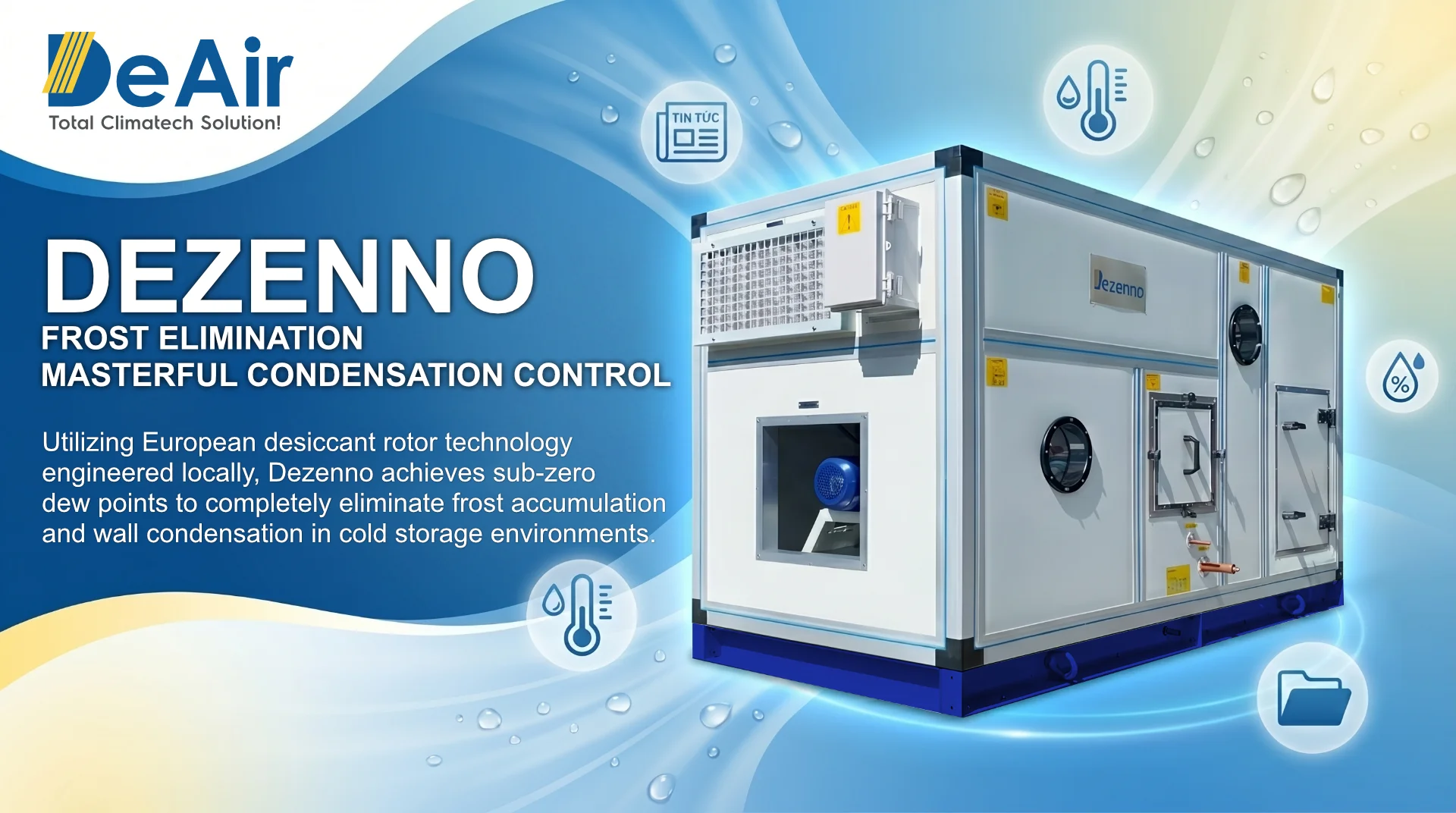
Sorption Psychrometric Control: Moderated produce cold rooms operate in low-temperature zones where mechanical refrigeration dehumidifiers freeze over. DeAir's Dezenno Desiccant Rotor solution extracts latent loads via physicochemical adsorption, preventing condensation and mold without altering cold storage thermal boundaries.
The global surge in consumer demand for organic produce and preservative-free "Clean Label" agricultural goods has evolved from a niche preference into an industry mandate for modern cold chains. However, stripping chemical interventions from post-harvest workflows completely dismantles artificial biosecurity, leaving fresh commodities vulnerable to exponential spoilage rates. This article evaluates these vulnerabilities from a plant physiology perspective and presents an advanced microclimate engineering framework powered by DeAir desiccant systems.
1. Post-Harvest Plant Physiology & The Volumetric Loss Trap
Unlike processed goods, harvested fruits and vegetables remain biologically active organisms. They continuously engage in two fundamental metabolic processes: Respiration and Transpiration. The kinetic rates of these processes dictate the storage longevity of clean commodities.
Metabolic Respiration Penalties: Plant tissues consume oxygen (O2) to break down stored sugars and nutrients, releasing carbon dioxide (CO2), water vapor, and metabolic heat. Sub-optimal environmental controls accelerate respiration kinetics, driving rapid senescence, tissue fibrousness, and nutrient depletion.
Transpiration & Volumetric Shrinkage: If the Relative Humidity (%RH) of the storage atmosphere drops below the internal vapor pressure of the plant cells, water will evaporate from the produce. This induces wilting, structural softening, and a direct loss in commercial weight yield.
The Condensation Trap: Conversely, maintaining ambient humidity too close to saturation or exposing the room to rapid thermal fluctuations during loading dock operations triggers surface condensation. These microscopic water droplets form a highly fertile substrate for fungal spores and bacterial colonies, causing accelerated rot in the absence of synthetic chemical coatings.
Deploying DeAir desiccant sorption technology allows for precise dew-point suppression, completely neutralizing the risk of surface sweating on cold produce.
2. The Invisible Accelerator: Ethylene Gas (C2H4) in Sealed Storage
In chemical-free agrologistics, an invisible yet highly destructive biological vector is Ethylene gas (C2H4). This gaseous phytohormone is naturally off-gassed by ripening plant organs or tissues experiencing mechanical duress (abrasions, compression, bruising).
When commodities are locked within an airtight cold room, endogenous Ethylene cannot escape and accumulates to toxic concentrations. It acts as an autocatalytic biological trigger: violently accelerating ripening cascades in adjacent storage slots, inducing chlorophyll degradation (yellowing) in leafy vegetables, prompting pedicel abscission, and triggering enzymatic bitterness in root crops.
⚠️ ENGINEERING DIRECTIVE: To achieve absolute biosecurity across organic cold chains, operators must integrate independent, specialized Ethylene scrubbing systems (such as potassium permanganate KMnO4 chemisorption beds, ozonation matrices, or photocatalytic reactors).
Please note: DeAir is a highly specialized manufacturer focusing exclusively on Industrial Dehumidification and Drying Systems; we do not engineer bio-gas filtration or Ethylene scrubbers. Combining a "DeAir Precision Dehumidification Matrix" with "Agricultural Ethylene Scrubbing Hardware" delivers the ultimate chemical-free preservation blueprint, doubling or tripling storage life naturally.
3. Psychrometric Tolerances Matrix across Agricultural Commodities
Preserving clean label food products demands an ultra-precise psychrometric roadmap. Below are the engineering baselines compiled by DeAir's thermal applications department:
Commodity Class
Storage Temperature
Relative Humidity (%RH)
Psychrometric Deviation Risk
Ethylene Sensitivity
Leafy Vegetables (Lettuce, spinach, broccoli)
0 degrees C to 2 degrees C
90% - 95%
<90%: Rapid wilting and mass loss. >95%: Petiole rot and structural softening.
Very High
Vulnerable Berries & Fruit (Strawberries, grapes)
0 degrees C to 1 degrees C
85% - 90%
High risk of Botrytis cinerea (gray mold) outbreaks during dew point transitions.
Elevated humidity triggers root sprouting, cellular germination, and basal rot.
Low
Tropical Produce (Tomatoes, bananas, mangoes)
12 degrees C to 15 degrees C
85% - 90%
Excess moisture induces pericarp degradation and fungal lesions.
Extremely High
4. Infographic: 3-Tier Mitigation for Preservative-Free Agrologistics
3-Layer Bio-Security Matrix Replacing Chemical Preservatives
1
STANDARD COLD STORAGE
Suppresses ambient dry-bulb temperatures to decelerate metabolic respiration kinetics within plant tissues.
2
DEAIR DESICCANT ROTOR
Maintains precise psychrometric thresholds using solid sorption matrices, eliminating surface sweating and mold vectors.
3
ETHYLENE SCRUBBER
(Procured separately by operator) Actively adsorbs and neutralizes gaseous C2H4, arresting cascading ripening propagation.
5. Why Standard Refrigeration Fails at Internal Humidity Balancing
Many facility operators assume that standard refrigeration evaporators are adequate for humidity control. In reality, conventional cooling coils condense moisture blindly via excessive surface temperature suppression, exposing organic products to two major operational defects:
Uncontrolled Moisture Strip (Over-Drying): Refrigeration coils strip water indiscriminately, pulling ambient humidity below the safety margin of leafy greens. This forces the produce to continuously transpire to reach equilibrium, wasting 5% to 12% of its sellable mass within days.
Perimeter Infiltration Inability: Every time antechamber or loading dock doors cycle open, hot, humid external air mass surges inside. Evaporator coils cannot process this massive influx of latent energy instantly in cool spaces, causing intense humidity spikes near dock zones—the exact point where mold spores first take hold.
6. Advanced Sorption Mitigation with Dezenno Rotor Infrastructure
As a leading specialist in industrial environmental engineering, DeAir provides optimized solid-sorption dehumidification configurations tailored for high-volume organic agricultural preservation:
Dezenno Desiccant Rotor Systems - Eliminating Low-Temperature Moisture Flux
Produce cold rooms typically operate within a cool dải (range) from 0 degrees C to 15 degrees C. In this psychrometric zone, mechanical condensation systems suffer heavy coil ice-ups, losing water extraction capacity. Attempting to reverse this via thermal defrost heaters reintroduces heat into the envelope, which triggers cell breakdown and accelerate rotting cascades.
The specialized Dezenno Dehumidifier for Cold Storage of Agricultural Products leverages high-capacity honeycomb silica gel desiccant wheels. The system separates moisture purely through physical-chemical adsorption, catching vapor molecules out of low-temperature environments without injecting sensible heat into the chilled storage space. Continuous dry-air recirculation keeps relative humidity strictly bound to the target design point (e.g., 90%), suppressing surface sweating and mold germination vectors perfectly.
DeAir industrial dehumidification machinery supporting large-scale agricultural agrologistics centers exporting to international markets.
7. Technical FAQ - Microclimate Control in Cold Warehousing
Q1: Can DeAir Dezenno Desiccant Rotors filter or scrub Ethylene gas directly?
A: No. DeAir specializes strictly in industrial dehumidification and industrial drying systems. The Dezenno rotor platform is engineered solely to manage relative humidity (%RH) and dew point matrices to prevent condensation and fungal spread in low-temperature zones. To handle Ethylene gas, operators must purchase independent bio-gas filtration or scrubbing hardware from agricultural biotechnology providers.
Q2: Why is a desiccant dryer required if leafy greens need high humidity (90% RH) anyway?
A: Leafy greens require high humidity to prevent moisture loss, but the threshold between 90% RH (safe preservation) and 98%-100% saturation (surface condensation) is paper-thin. When dock doors cycle, external latent infiltration instantly drives the local air mass to saturation, causing liquid water to pool on the leaves and trigger bacterial soft rot. The Dezenno desiccant system acts as a precision microclimate governor, trimming out excess latent spikes to keep humidity locked at a stable 90%-92% without crossing into condensation thresholds.
Q3: Does DeAir's dehumidification system protect cardboard packaging from collapse?
A: Yes. Export-grade produce is routinely packed in corrugated paper cartons. When warehouse humidity crosses 85% RH, the paper's cellulose fibers absorb moisture, causing a 50% to 60% drop in box structural rigidity and leading to pallet stack collapses. By regulating ambient humidity to exact psychrometric baselines, DeAir preserves packaging integrity, safeguarding your inventory throughout storage and transit.
Elevate Your Organic Produce Value Chain
Mastering the physical parameters of cold storage climates is the only sustainable path to completely replacing post-harvest chemical preservatives. Partner with DeAir's MEP engineering group to evaluate latent loads and deploy optimized Dezenno desiccant rotor matrices for your agricultural logistics facilities.


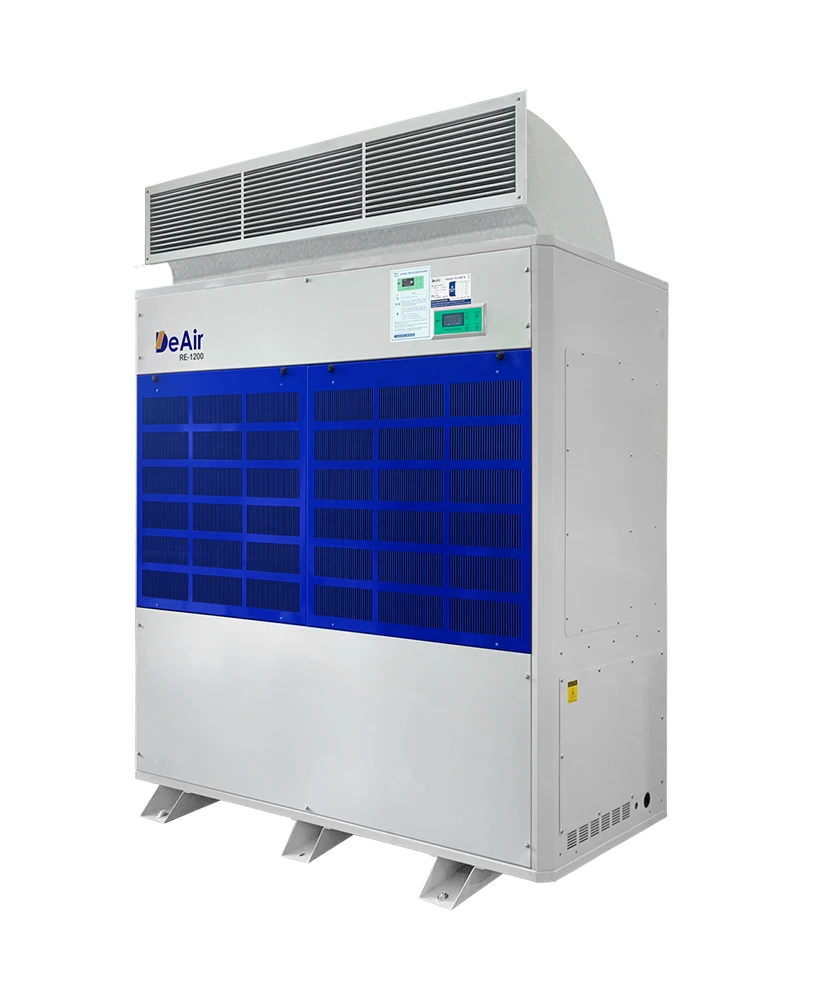 DeAir.RE
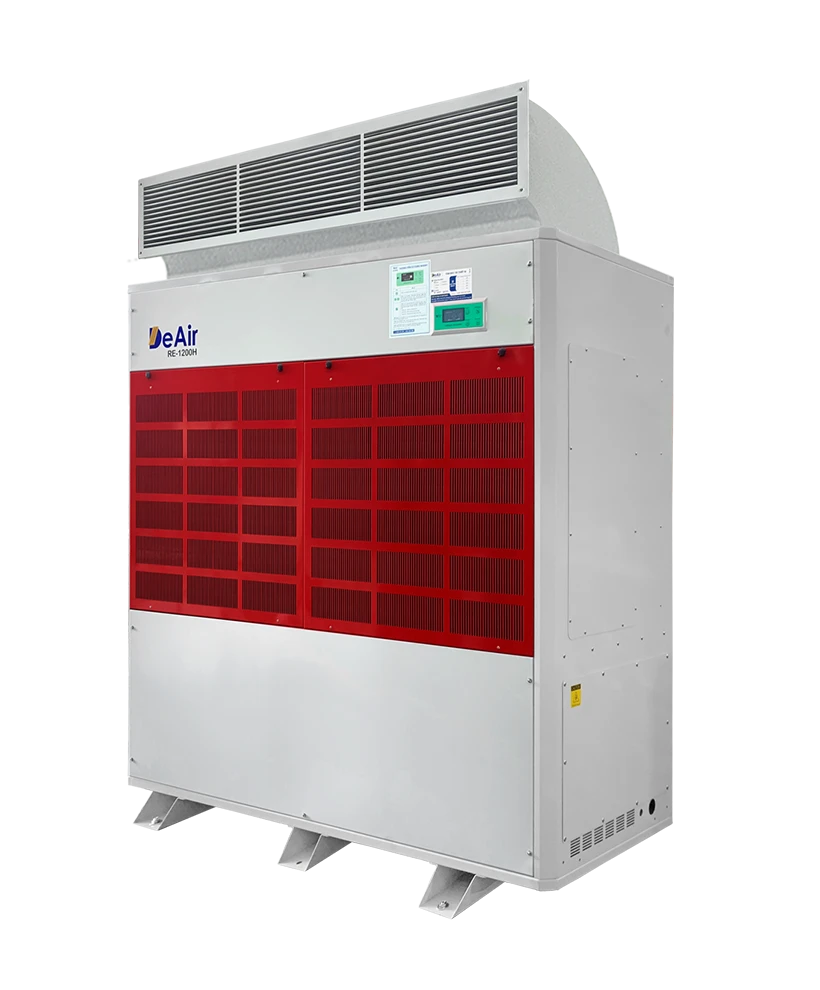 DeAir.RE-H
 DeAir.RE-INOX
 DeAir.CRE
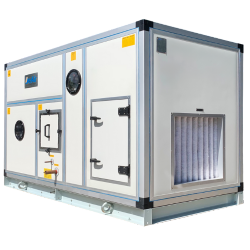 Dezenno
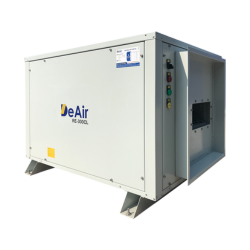 DeAir.RE-CL
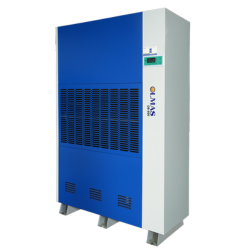 Olmas-OS
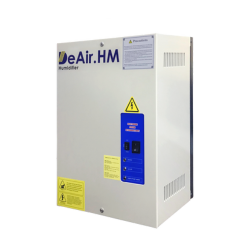 DeAir.HM
 Daxwell
 DeAir.Heat
 AHU
AHU







![[Case Study] DeAir Installs DeAir.De Rotor Humidity Control System for Pharmaceutical Plant in Binh Duong](https://deair.com.vn/thumbs/news/2023_04/ban_giao_may_cho_duoc_bd/[270x153-cr]image1-1024x772.jpg__cv.webp "[Case Study] DeAir Installs DeAir.De Rotor Humidity Control System for Pharmaceutical Plant in Binh Duong")
![[Review & Guide] Olmas OS-300: The New Humidity Control "Warrior" for Medium to Large Warehouses](https://deair.com.vn/thumbs/news/huong_dan_su_dung_may_olmas_21/[270x153-cr]vtm06440.png "[Review & Guide] Olmas OS-300: The New Humidity Control \"Warrior\" for Medium to Large Warehouses")