Context: A seafood factory in Tay Ninh requires high-corrosion-resistant dehumidification equipment for salty, high-humidity environments.
Specific Challenge: Difficult installation location (narrow spaces, small staircases, or restricted access areas) makes monolithic transportation impossible.
The Solution: DeAir.RE-600H stainless steel heat-pump dehumidifier with superior corrosion resistance, transported flexibly as modules and professionally assembled on-site.
The Result: Stable equipment operation, compliance with food safety standards, protection of equipment and goods from corrosion, and complete resolution of logistics challenges.
1. Specific Challenges of Tay Ninh Seafood Factory
1.1. Harsh Environment: The Enemy of Metal Equipment
Seafood factories with high salinity and continuous humidity >80% RH are the "enemy" of conventional metal equipment. In this environment, standard painted steel equipment is prone to rapid rust and corrosion, leading to reduced equipment lifespan and product contamination risks.
1.2. Food Safety and Hygiene Requirements
Equipment must be easy to clean, prevent bacterial accumulation, and comply with HACCP/ISO 22000 standards. Stainless steel casing is a mandatory choice to ensure no food safety hazards arise.
1.3. The "Difficult" Logistics Problem
️ TRANSPORTATION CHALLENGE
The specific installation location makes transporting monolithic equipment (typically very bulky for the 600kg/day model) impossible. Narrow staircases, small elevators, or tight passages require a flexible installation solution.
2. The Solution: DeAir.RE-600H Stainless Steel Heat-Pump Dehumidifier
2.1. Why Choose Stainless Steel for the Seafood Industry?
SUPERIOR ADVANTAGES OF STAINLESS STEEL CASING
Absolute corrosion resistance: Operates durably in salty/high-humidity environments without rusting.
To solve the complex logistics challenge, DeAir implemented a professional modular installation process, demonstrating superior technical capability:
3.1. Survey & Modularization Planning
DeAir engineers surveyed the site, identifying difficult points (narrow staircases, small elevators, tight passages). Based on this, they planned to disassemble the machine into main modules: Machine frame, Evaporator/Condenser coils, Compressor, Control cabinet, Stainless steel casing.
3.2. Safe Transportation of Individual Modules
Each component was individually packaged with shock-absorbing materials and transported directly to the construction site in Tay Ninh. This process ensured no damage during movement through restricted areas.
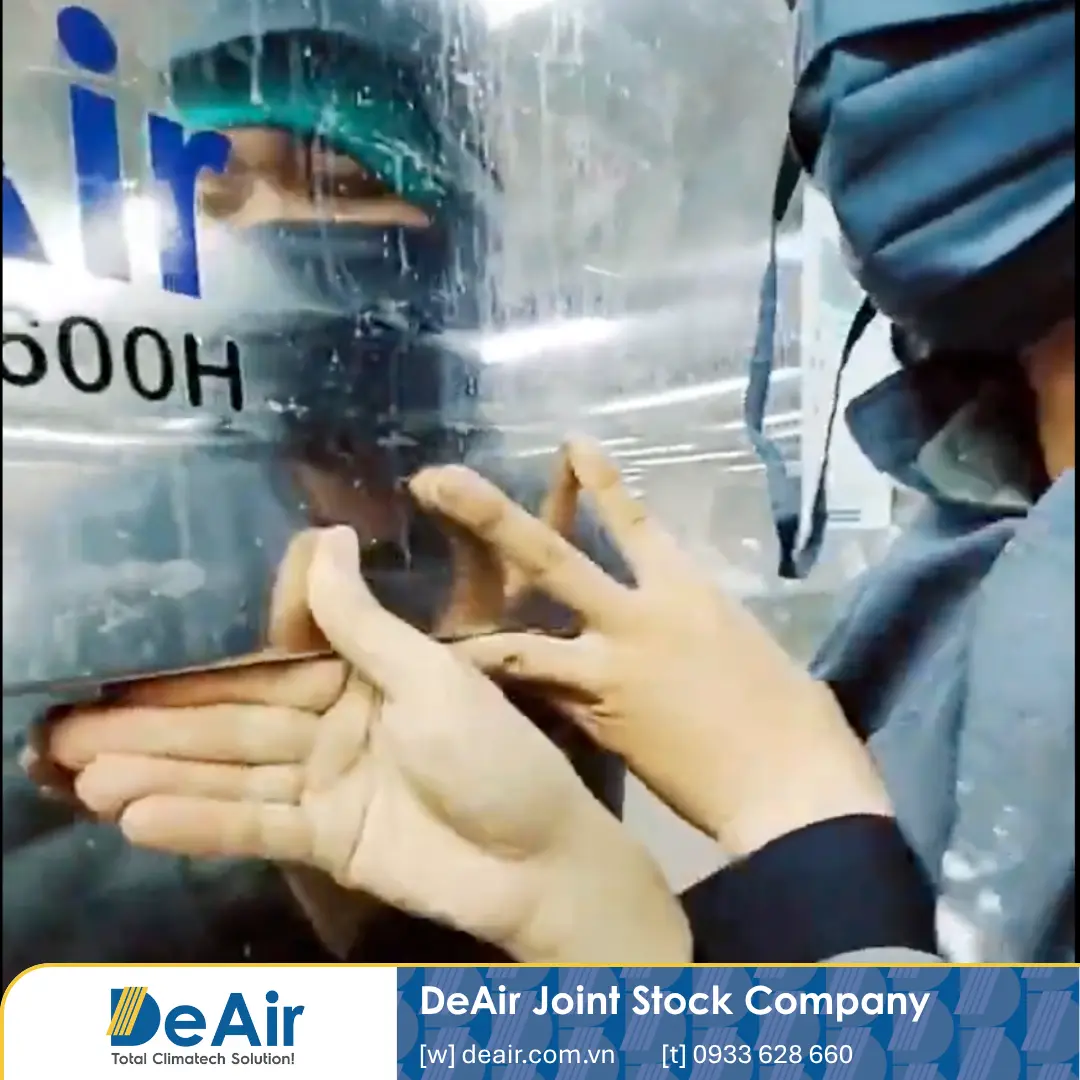
DeAir engineers carefully transport dehumidifier modules into the installation position through restricted access areas.
3.3. On-Site Assembly & Completion
DeAir's skilled technical team proceeded to assemble the machine frame, heat exchangers, and electrical systems directly at the installation location. For the stainless steel casing, pre-fabricated panels with high precision were assembled to completion, ensuring airtightness, aesthetics, and durability equivalent to a monolithic unit.
DeAir technical team professionally assembling dehumidifier modules directly at the construction site.
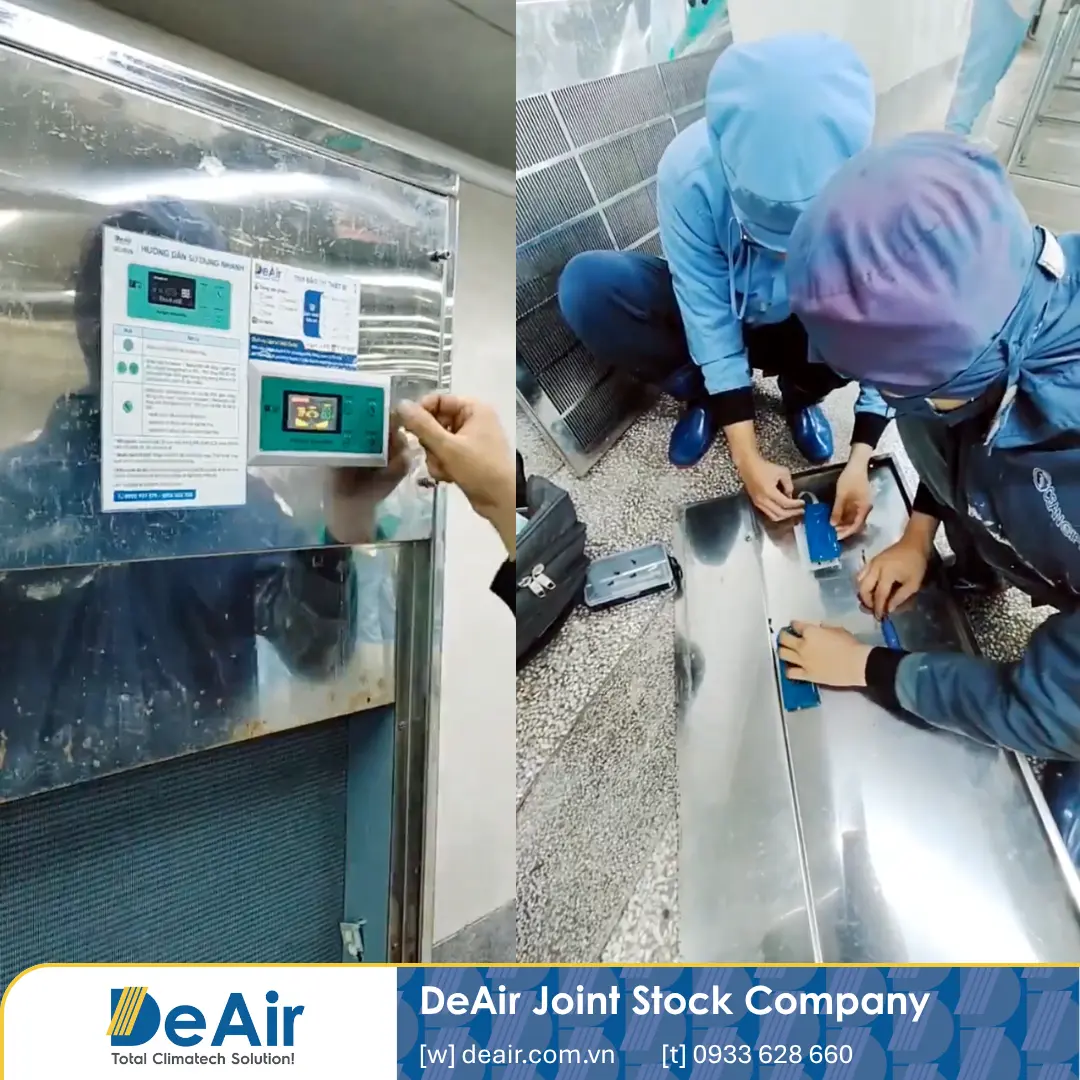
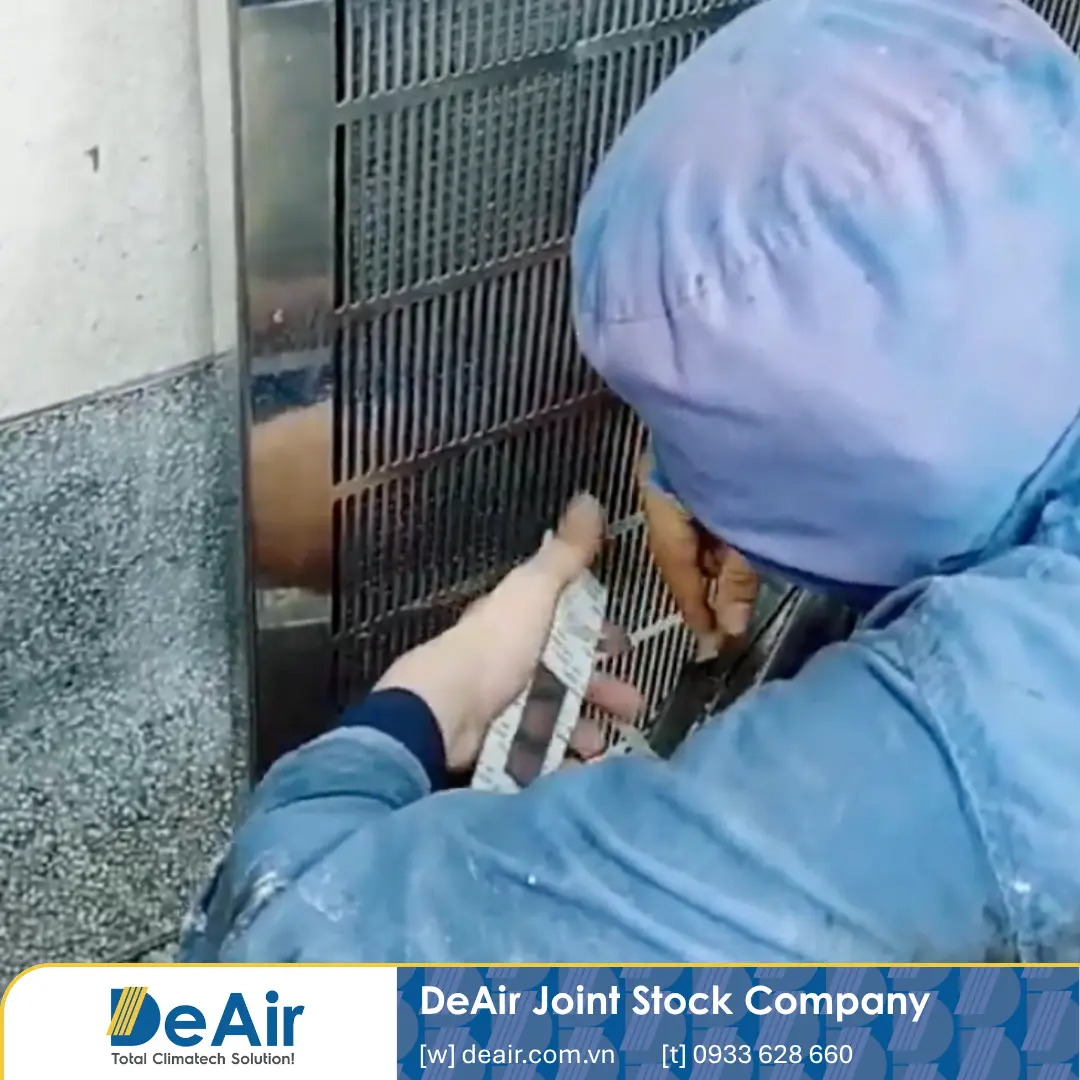
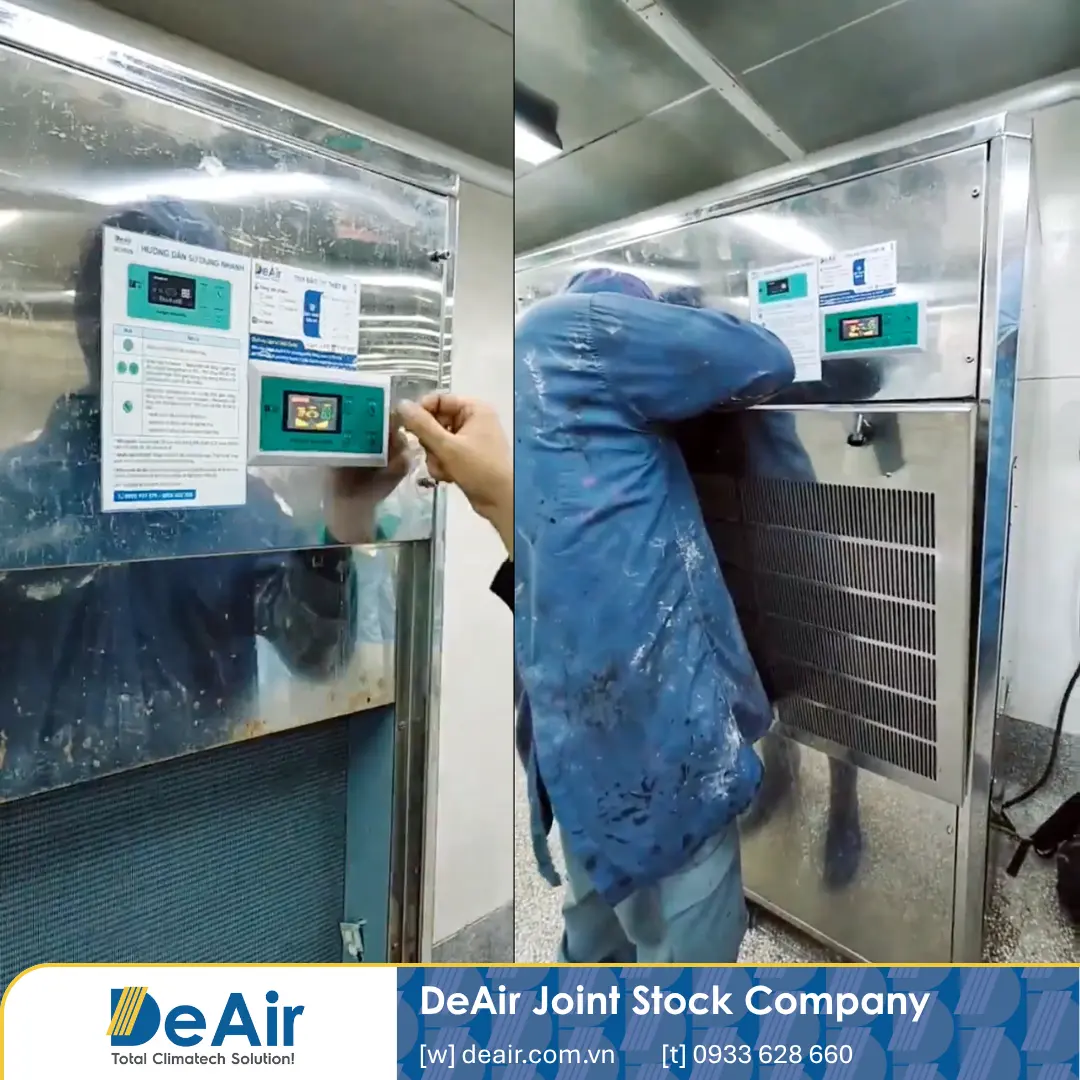
Installing the control panel and filter cover with high precision to ensure stable operation.
3.4. Test Run & Calibration
After completing the assembly, technicians proceeded with refrigerant charging, pressure checks, system test runs, and calibration of target humidity setpoints. Finally, they trained the factory staff on equipment operation.
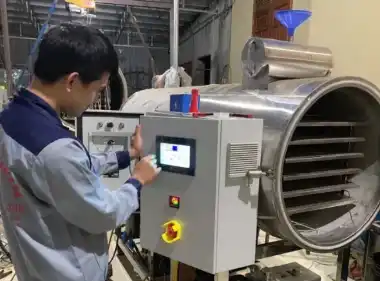
The DeAir.RE-600H stainless steel dehumidifier is completed and ready for operation after testing and calibration.
4. Achieved Results
4.1. Technical Performance
Stable machine operation with low noise, warehouse humidity controlled at 45-55% RH.
Smooth system operation, fully meeting designed technical specifications.
Airtightness and aesthetics meeting monolithic unit standards.
4.2. Durability
Stainless steel casing ensures no rust after years of operation in salty environments.
Easy to clean and maintain, meeting food safety and hygiene standards.
Equipment lifespan extended 2-3 times compared to conventional steel casing.
4.3. Logistics
Completely solved the transportation problem into difficult positions without needing large cranes or structural demolition.
Optimized construction time without disrupting factory production activities.
Effective control of transportation and installation costs.
5. Infographic: Monolithic vs. Modular Installation Comparison
COMPARISON: MONOLITHIC VS. ON-SITE MODULAR INSTALLATION
Criteria
Monolithic Installation
On-Site Modular Installation (DeAir)
Access to Difficult Locations
Limited (requires wide space)
Flexible (can pass narrow staircases)
Construction Time
Fast (if accessible)
Optimized (no demolition needed)
Transportation Damage Risk
High (bulky equipment)
Low (compact modules)
Flexibility
Low
High (adapts to any location)
Post-Installation Quality
Standard
Standard equivalent to monolithic
6. Frequently Asked Questions (FAQ)
Q1: Does on-site assembly affect the durability and airtightness of the machine?
Not at all. DeAir uses a professional modular assembly process with stainless steel panels precisely manufactured at the factory. The joints are designed to ensure absolute airtightness, and our skilled technical team ensures installation quality meets monolithic unit standards.
Q2: Why must seafood factories use stainless steel casing machines?
Seafood factory environments have high salinity and continuous humidity >80% RH, which are ideal conditions for metal corrosion. Stainless steel casing (304/316) has absolute corrosion resistance, is easy to clean, prevents dirt accumulation, and meets HACCP/ISO 22000 food safety standards. The lifespan of stainless steel machines is 2-3 times longer than painted steel casing in this environment.
Q3: Does on-site modular installation take longer than monolithic installation?
The time may be slightly longer compared to monolithic placement (if accessible), but in return, the modular method saves transportation time and costs, doesn't require large cranes, and avoids structural demolition. The total time from transportation to completion is typically optimized and does not disrupt factory production.
Q4: Does DeAir provide warranty for on-site assembled parts?
Yes. DeAir applies a 24-month warranty policy for the entire system, including on-site assembled parts. We commit to installation quality meeting standards and provide lifetime warranty and maintenance for the equipment.
Don't Let Corrosive Environments Destroy Your Equipment!
With flexible installation capabilities and specialized stainless steel solutions, DeAir commits to delivering durable, high-hygiene equipment suitable for any difficult installation position in your seafood factory.


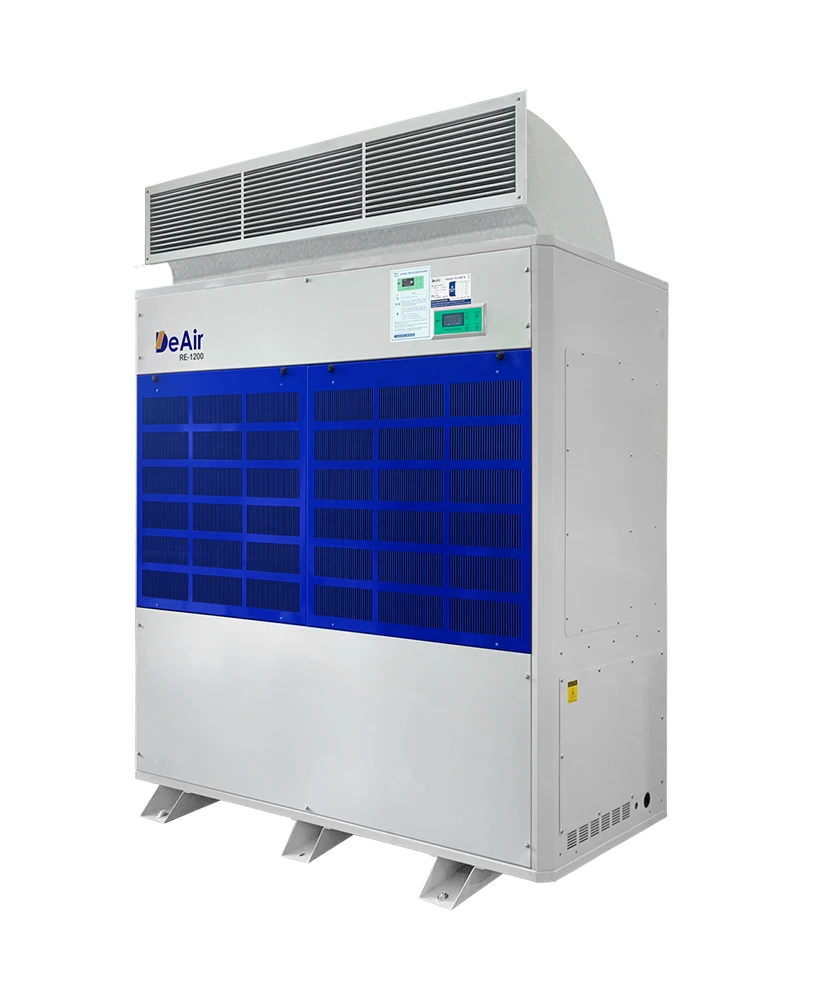 DeAir.RE
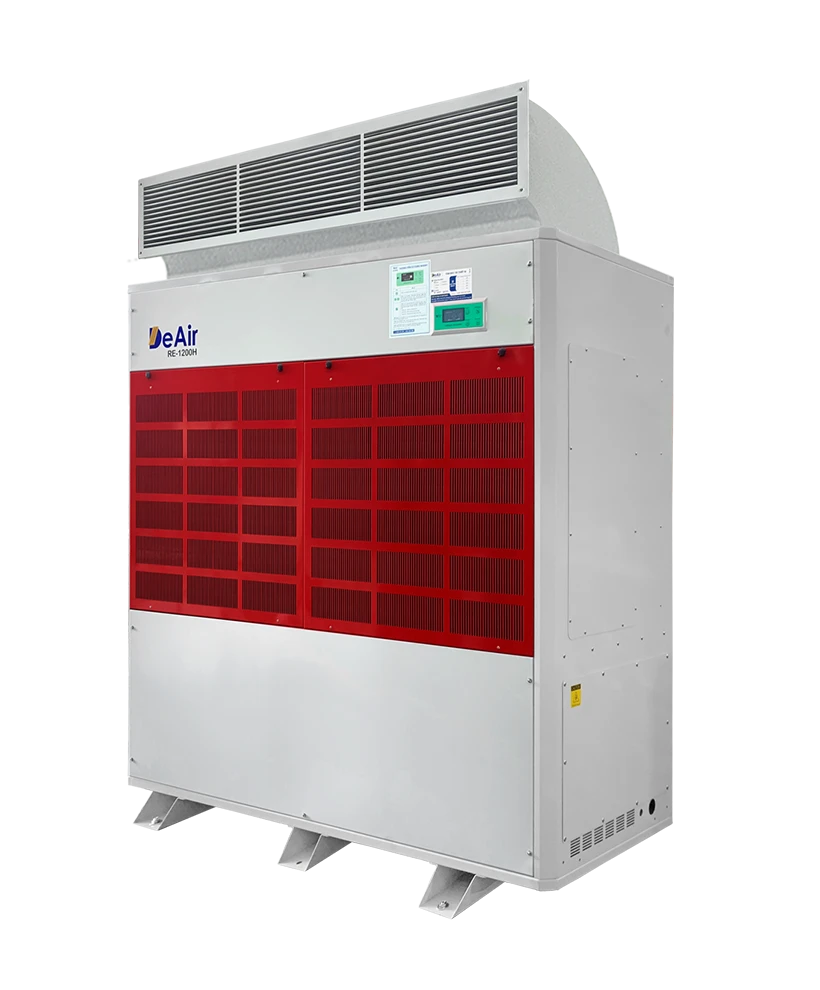 DeAir.RE-H
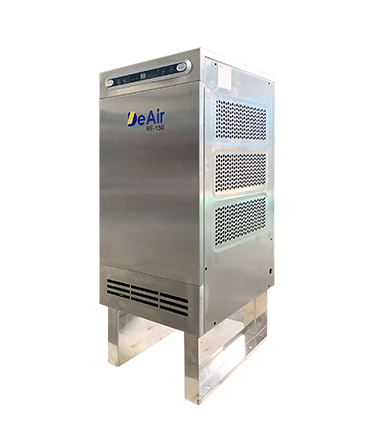 DeAir.RE-INOX
 DeAir.CRE
 Dezenno
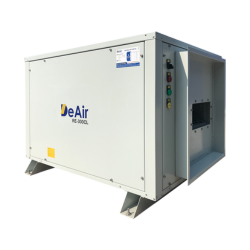 DeAir.RE-CL
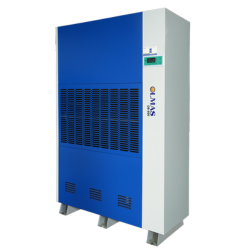 Olmas-OS
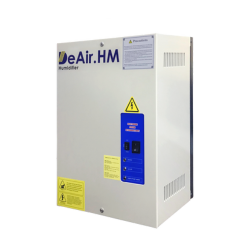 DeAir.HM
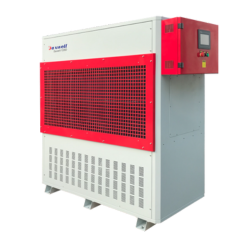 Daxwell
 DeAir.Heat
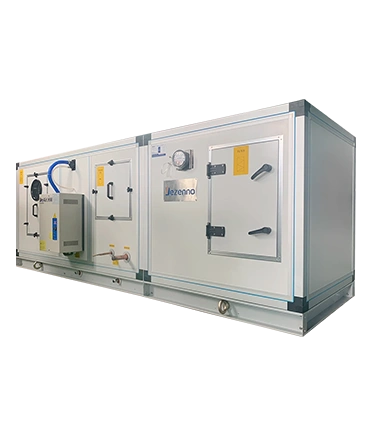 AHU
AHU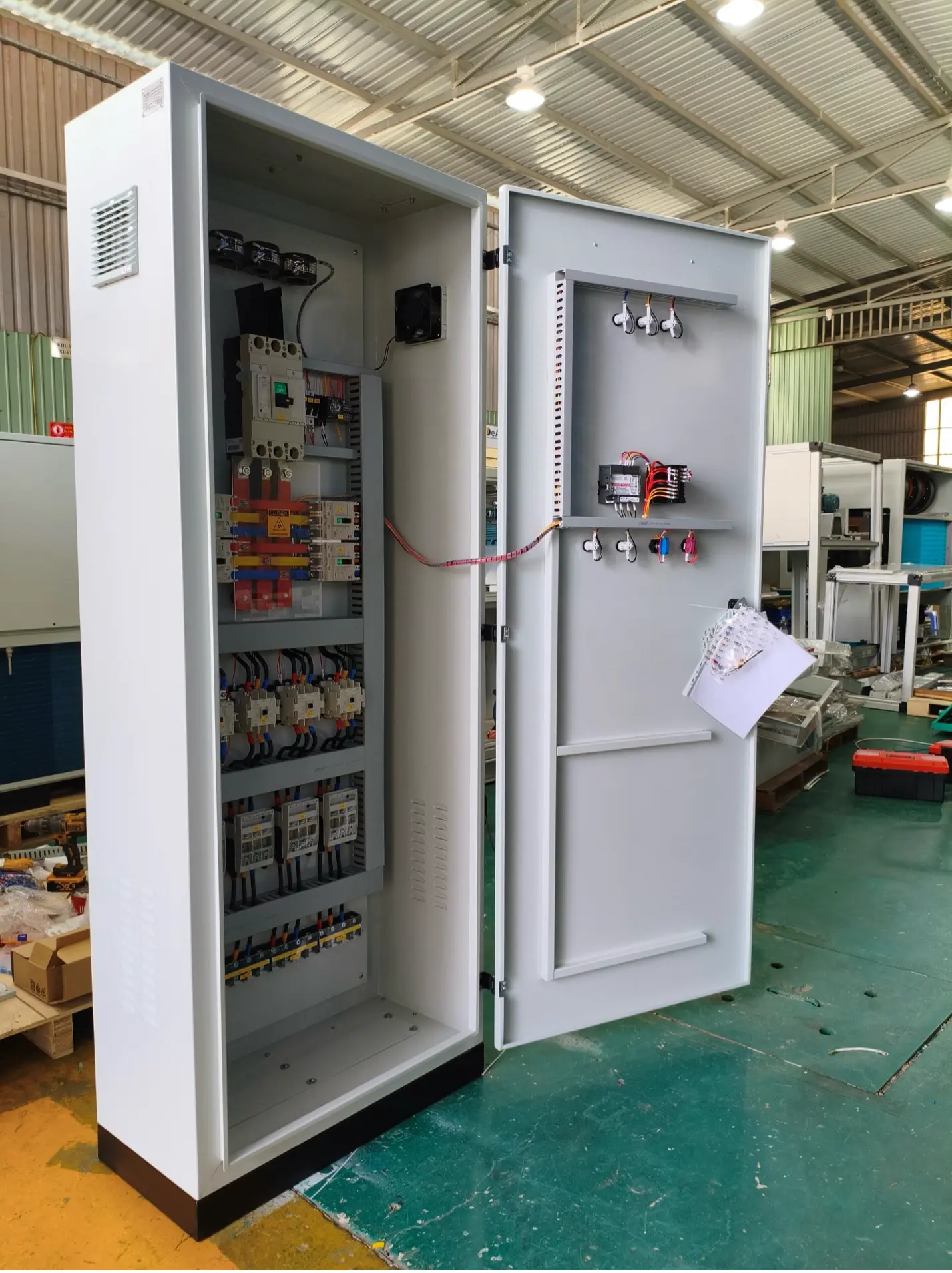





![[Case Study] DeAir Installs DeAir.De Rotor Humidity Control System for Pharmaceutical Plant in Binh Duong](https://deair.com.vn/thumbs/news/2023_04/ban_giao_may_cho_duoc_bd/[270x153-cr]image1-1024x772.jpg__cv.webp "[Case Study] DeAir Installs DeAir.De Rotor Humidity Control System for Pharmaceutical Plant in Binh Duong")

![[Review & Guide] Olmas OS-300: The New Humidity Control "Warrior" for Medium to Large Warehouses](https://deair.com.vn/thumbs/news/huong_dan_su_dung_may_olmas_21/[270x153-cr]vtm06440.png "[Review & Guide] Olmas OS-300: The New Humidity Control \"Warrior\" for Medium to Large Warehouses")