Context: An electronic components factory in Binh Duong required a cleanroom for finished goods storage with a specific technical requirement: maintaining high temperature but ultra-low humidity.
Challenge: Traditional condensation (heat-pump) dehumidifiers cannot achieve low dew points in high-temperature environments.
Solution: Installation of a Dezenno rotor dehumidifier system (European standard), specifically designed for ultra-low humidity applications.
Result: The system operates stably, passed rigorous testing by an independent 3rd-party verification agency, ensuring absolute safety for high-value electronic components.
1. Technical Challenges: The "Paradoxical" Requirement in Electronic Components Storage
1.1. Specific Requirements
Storing finished electronic components (PCBA, ICs, sensors...) often requires an environment with high temperature (to prevent condensation when moved to ambient environments) but ultra-low humidity (typically < 10-20% RH or a very low dew point) to prevent lead oxidation and the "popcorn" effect (cracking caused by trapped moisture in ICs during soldering).
1.2. Limitations of Traditional Technology
⚠️ TECHNICAL LIMITATIONS
Standard heat-pump dehumidifiers: Will experience evaporator coil freezing or lose efficiency entirely when attempting to lower humidity to extreme levels in high-temperature environments.
Dew point constraints: Cannot achieve dew points < 10°C with traditional condensation technology.
Performance drop: Ineffective operation when humidity requirements drop below 30% RH.
1.3. Pressure from Binh Duong's Climate
The year-round high temperature and humidity in Binh Duong create a massive infiltration moisture load, demanding equipment with superior capacity and stability to maintain a dry internal cleanroom environment.
Desiccant Technology: Utilizes a silica gel rotor wheel, capable of effective dehumidification even at very low dew points, regardless of ambient temperature.
European Standards: Manufactured to European standards, researched and applied by DeAir for over 20 years in Vietnam.
Ultra-low humidity: Capable of achieving < 10% RH or dew points < -40°C.
Stable operation: Unaffected by the high temperatures of the cleanroom.
2.2. Optimized Operating Mechanism
The Dezenno system operates with two independent air streams:
Process Air: Humid air from the cleanroom passes through the rotor, is dehumidified, and returned to the room.
Regeneration Air: Heated air is used to reactivate the rotor, removing the absorbed moisture.
This mechanism ensures thorough moisture removal without being compromised by the room's high temperature.
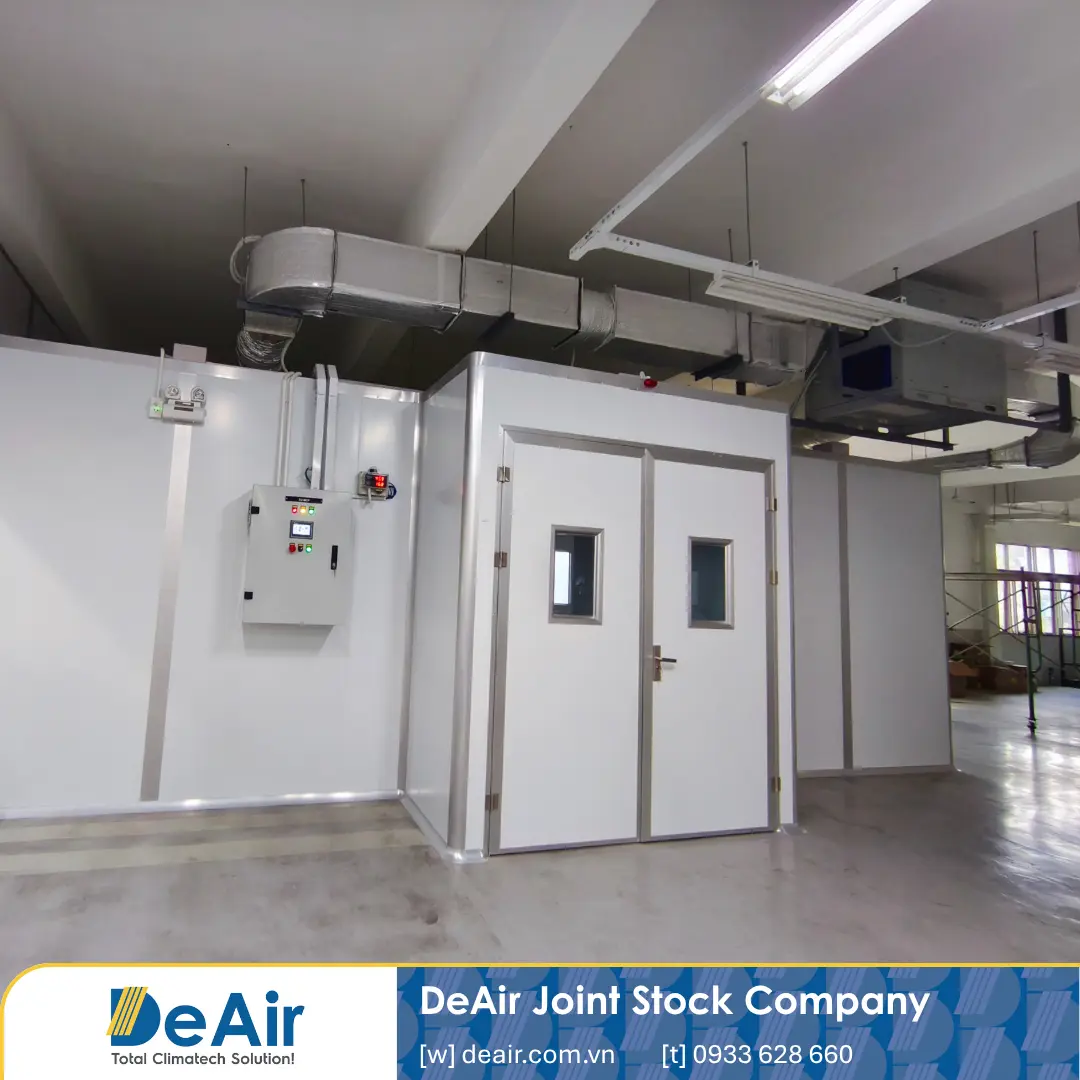
Electronic components storage cleanroom with precise temperature and humidity control systems
2.3. Integrated Control System
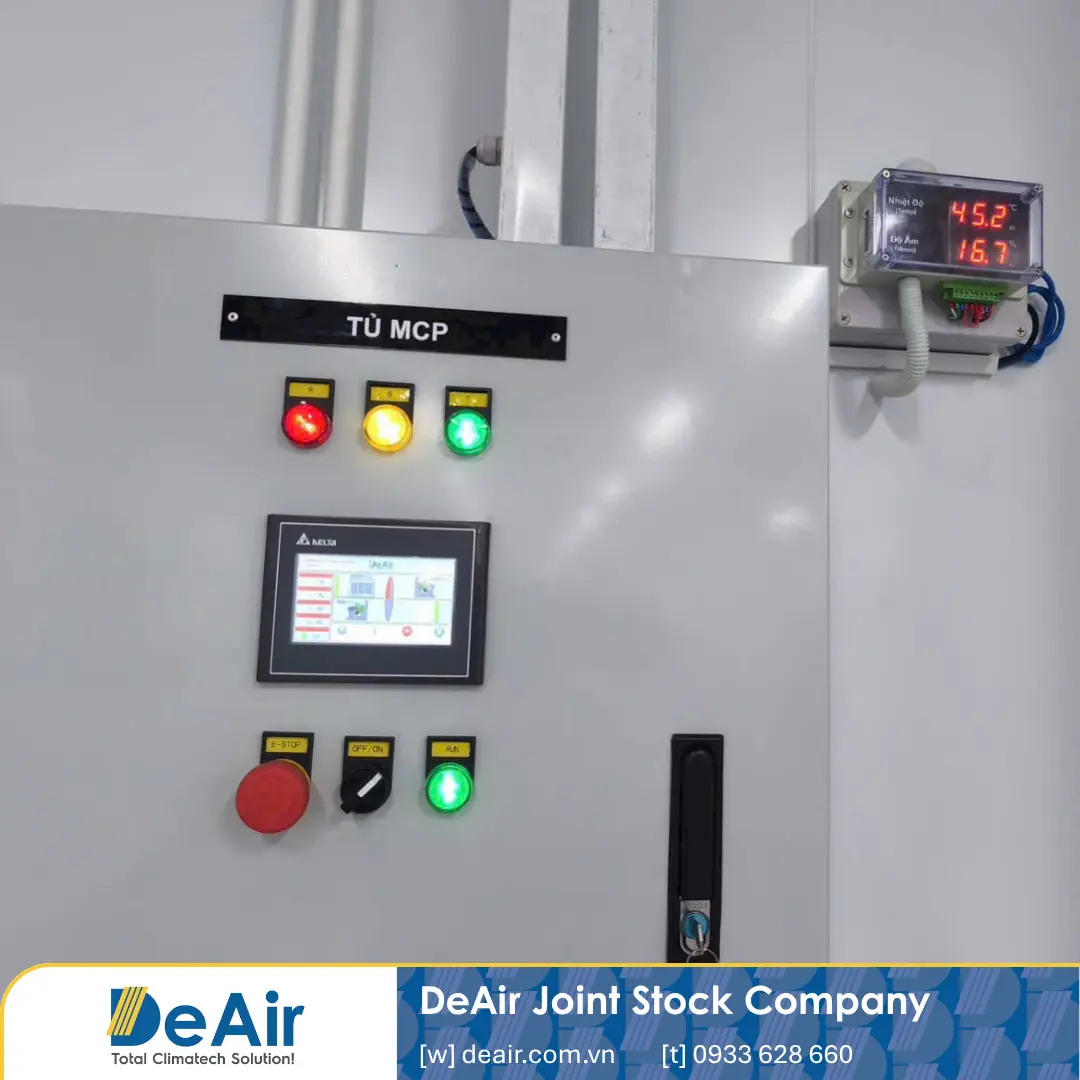
The system is equipped with variable frequency drives (VFD) and a PLC controller that automatically adjusts capacity, ensuring an accuracy of ±1-2% RH, meeting the strict demands of the electronics industry.
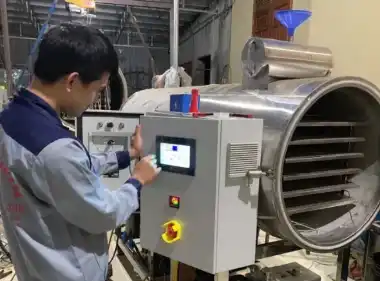
PLC control cabinet and high-precision temperature-humidity sensor system
To ensure the system meets strict Cleanroom standards and electronic components storage requirements (IPC/JEDEC), the investor required an independent, reputable verification agency (e.g., Quatest 3, VILAS, or a professional HVAC testing firm) to conduct the assessment.
3.2. Verification Items Passed
✅ VERIFICATION ITEMS
Temperature and humidity uniformity: Grid testing at multiple points in the room to ensure no localized "dead spots" of humidity.
Recovery time: The time required for the system to restore target humidity after the room door is opened.
Air cleanliness (Particle count): Ensuring the Dezenno system's filters do not generate particles, meeting the required cleanroom class.
Noise and vibration: Ensuring no interference with surrounding precision measurement equipment.
3.3. Results
100% of parameters met and exceeded the technical requirements stated in the contract. The independent verification report serves as the clearest proof of the quality and effectiveness of the solution provided by DeAir.
Video of the verification and acceptance process for the Dezenno rotor dehumidifier system
4. Professional Handover and Acceptance Process
Step 1: Site Survey and Moisture Load Calculation
DeAir engineers conducted a detailed survey of the cleanroom in Binh Duong: measuring volume, calculating infiltration moisture load, and analyzing specific temperature-humidity requirements for each type of electronic component.
Step 2: Dezenno System Installation
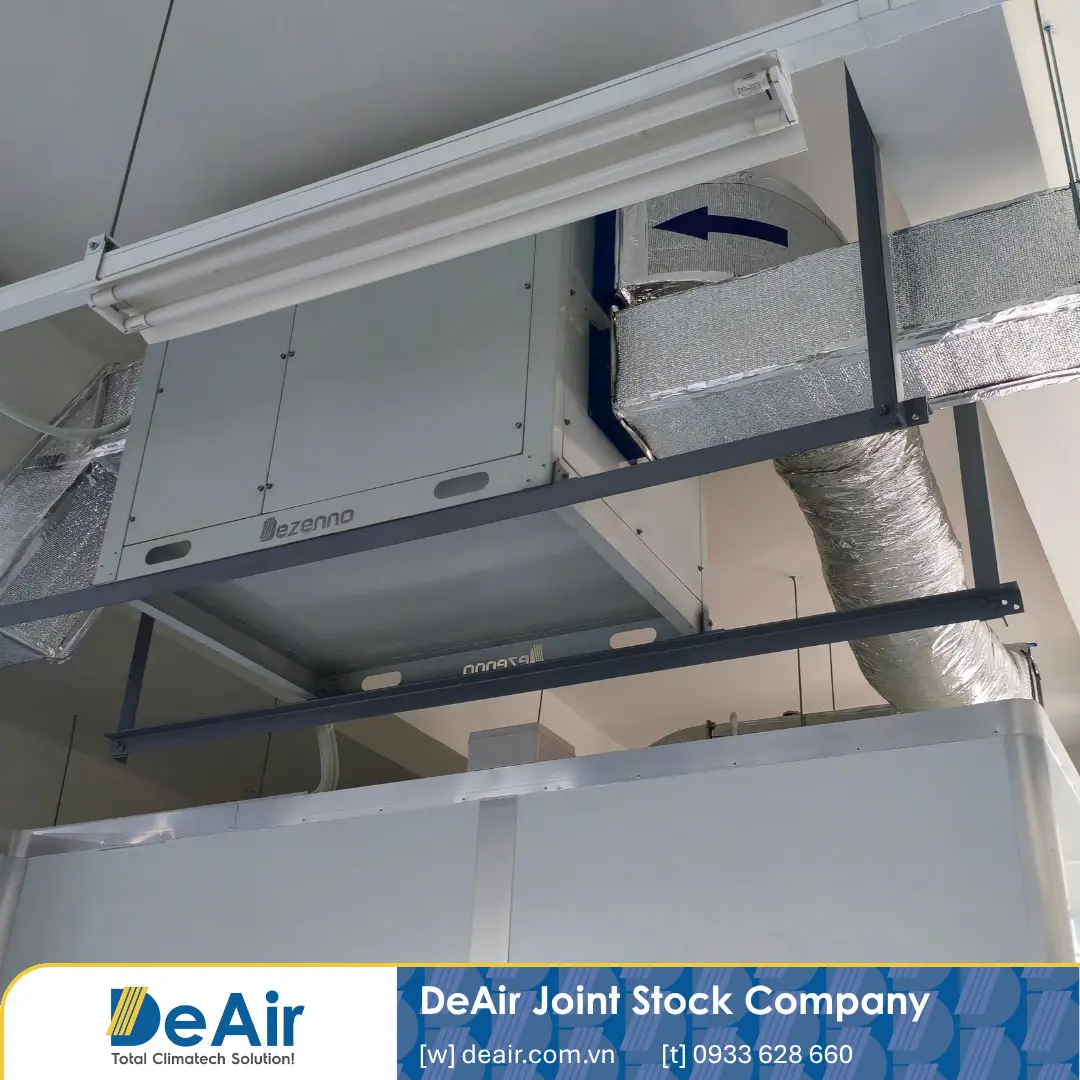
Installation of the Dezenno rotor dehumidifier, connecting supply/return air ducts and the PLC electrical control system. Ensuring optimal placement for easy maintenance and operation.
The Dezenno rotor dehumidifier installed outside the cleanroom, connected via specialized ductwork
Step 3: Commissioning and Calibration
Conducting system test runs alongside the factory's engineers, calibrating parameters on the PLC controller to achieve the target humidity of < 20% RH at high temperatures.
Step 4: Coordination with 3rd-Party for Verification
Coordinating with the independent verification agency to conduct comprehensive system testing according to IPC/JEDEC and Cleanroom standards. Result: 100% compliance.
Step 5: As-Built Documentation Handover and Training
Handing over as-built documentation, independent verification reports, operation manuals, and training factory personnel on system operation, monitoring, and maintenance.
5. Achieved Results
5.1. Technical Performance
Stable humidity: Maintained at < 20% RH at high temperatures (25-30°C).
High precision: ±1-2% RH accuracy thanks to the PLC control system and VFD.
Uniformity: No localized "dead spots" of humidity throughout the cleanroom.
Recovery capability: Humidity recovery time after door opening is < 15 minutes.
5.2. Component Quality
Oxidation prevention: Component leads remain free from oxidation during storage.
"Popcorn" effect prevention: Eliminates the risk of IC cracking due to absorbed moisture.
IPC/JEDEC compliance: Ensures component quality prior to assembly.
Extended storage life: Components can be stored long-term without quality degradation.
5.3. Reputation and Trust
Independent verification report: Objective proof of system quality.
International standards compliance: Meets the stringent requirements of the electronics industry.
Customer confidence: The investor has absolute peace of mind regarding the quality of the solution provided by DeAir.
6. Infographic: Cleanroom Standards for Electronic Components Storage
📊 CLEANROOM STANDARDS FOR ELECTRONIC COMPONENTS STORAGE
🌡️
TEMPERATURE
25-30°C
Stable, prevents condensation
💧
HUMIDITY
< 20% RH
Ultra-low, prevents oxidation
🎯
PRECISION
±1-2% RH
Automated PLC control
⏱️
RECOVERY
< 15 mins
After room door opening
7. Frequently Asked Questions (FAQ)
Q1: Why does an electronic components storage cleanroom require both high temperature and low humidity simultaneously?
High temperature (25-30°C) helps prevent condensation when components are moved to ambient environments. Ultra-low humidity (< 20% RH) prevents lead oxidation and the "popcorn" effect (IC cracking due to absorbed moisture). This is a mandatory requirement under the IPC/JEDEC J-STD-033 standard for Moisture Sensitive Devices (MSD).
Q2: How does a Dezenno rotor dehumidifier differ from a standard heat-pump dehumidifier?
The Dezenno rotor dehumidifier uses desiccant technology with a silica gel wheel, capable of achieving ultra-low humidity (< 10% RH) and very low dew points (< -40°C) even at high temperatures. In contrast, heat-pump dehumidifiers are only effective at humidity levels > 30% RH and will lose efficiency or freeze at low temperatures/ultra-low humidity.
Q3: What benefits does 3rd-party verification bring to the investor?
Independent 3rd-party verification (e.g., Quatest, VILAS) provides: (1) Objectivity and transparency, (2) Assurance that the system meets IPC/JEDEC and Cleanroom standards, (3) A legal verification report proving compliance, (4) Absolute confidence in system quality before official operation.
Q4: Is the maintenance cost for the Dezenno rotor wheel high and complex?
The maintenance cost for a Dezenno rotor is very reasonable. The rotor wheel has a lifespan of 5-10 years depending on operating conditions. DeAir provides scheduled maintenance every 6 months, including filter cleaning, regeneration heater checks, and sensor calibration. With a nationwide technician network and readily available spare parts, DeAir ensures rapid and effective support.
Do Not Compromise on the Quality of Your Electronic Components!
With our independently verified Dezenno rotor dehumidifier solutions, DeAir commits to delivering optimal storage environments that meet IPC/JEDEC standards for your high-value electronic components.
Contact us now for professional cleanroom solution consultation!


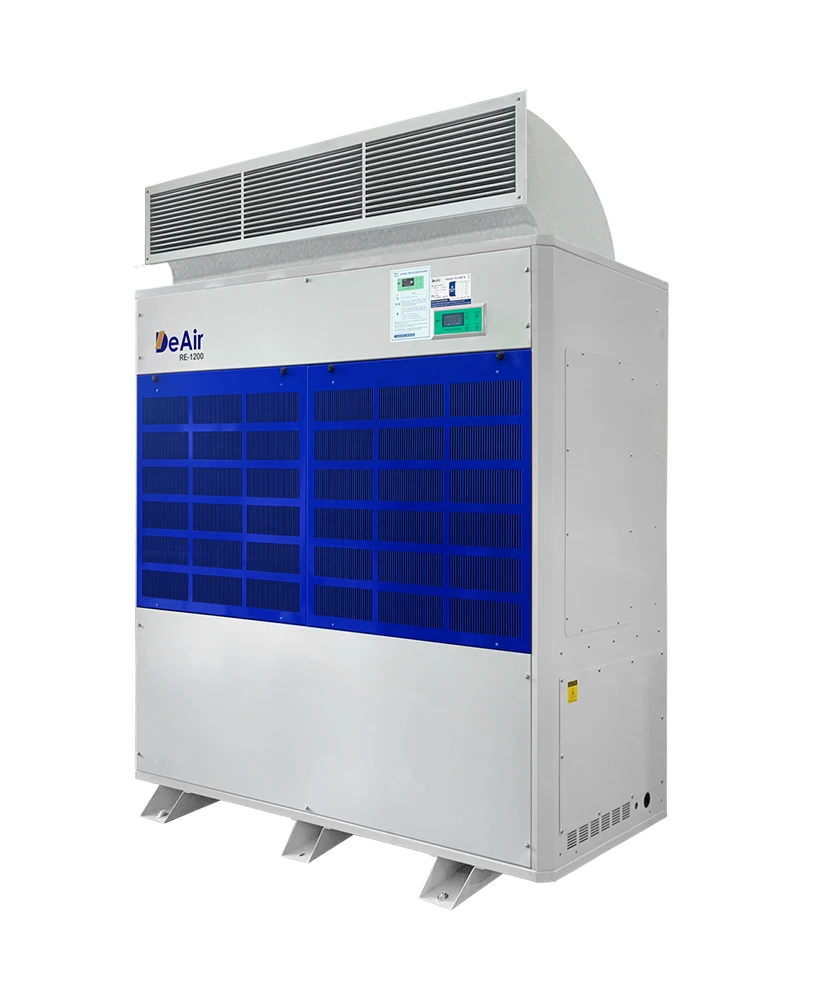 DeAir.RE
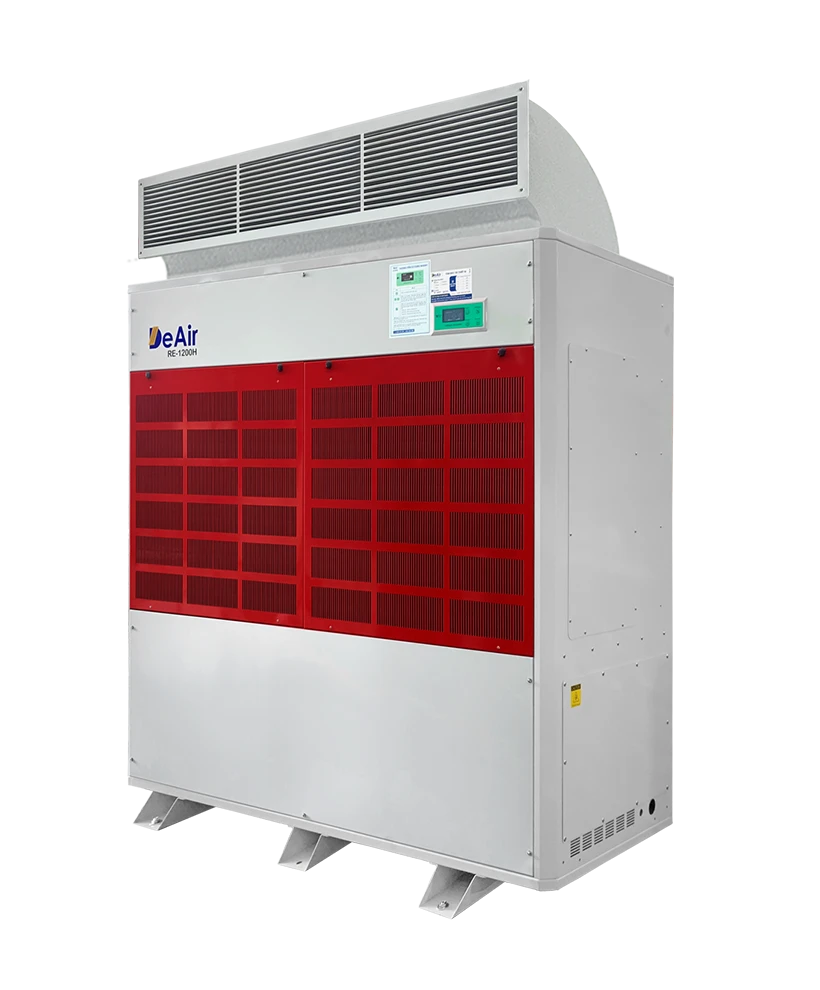 DeAir.RE-H
 DeAir.RE-INOX
 DeAir.CRE
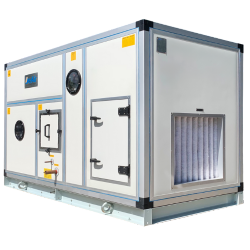 Dezenno
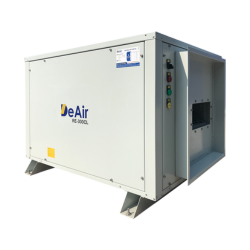 DeAir.RE-CL
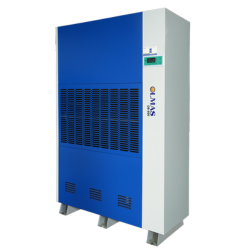 Olmas-OS
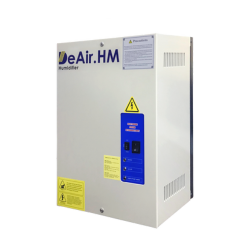 DeAir.HM
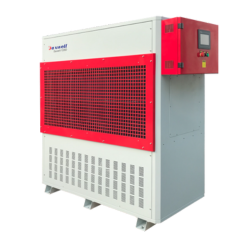 Daxwell
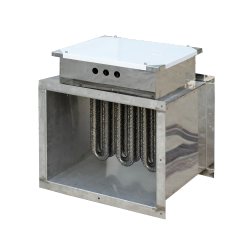 DeAir.Heat
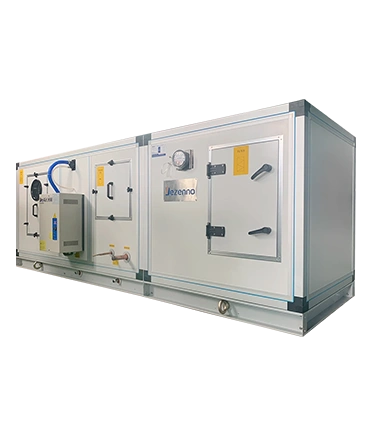 AHU
AHU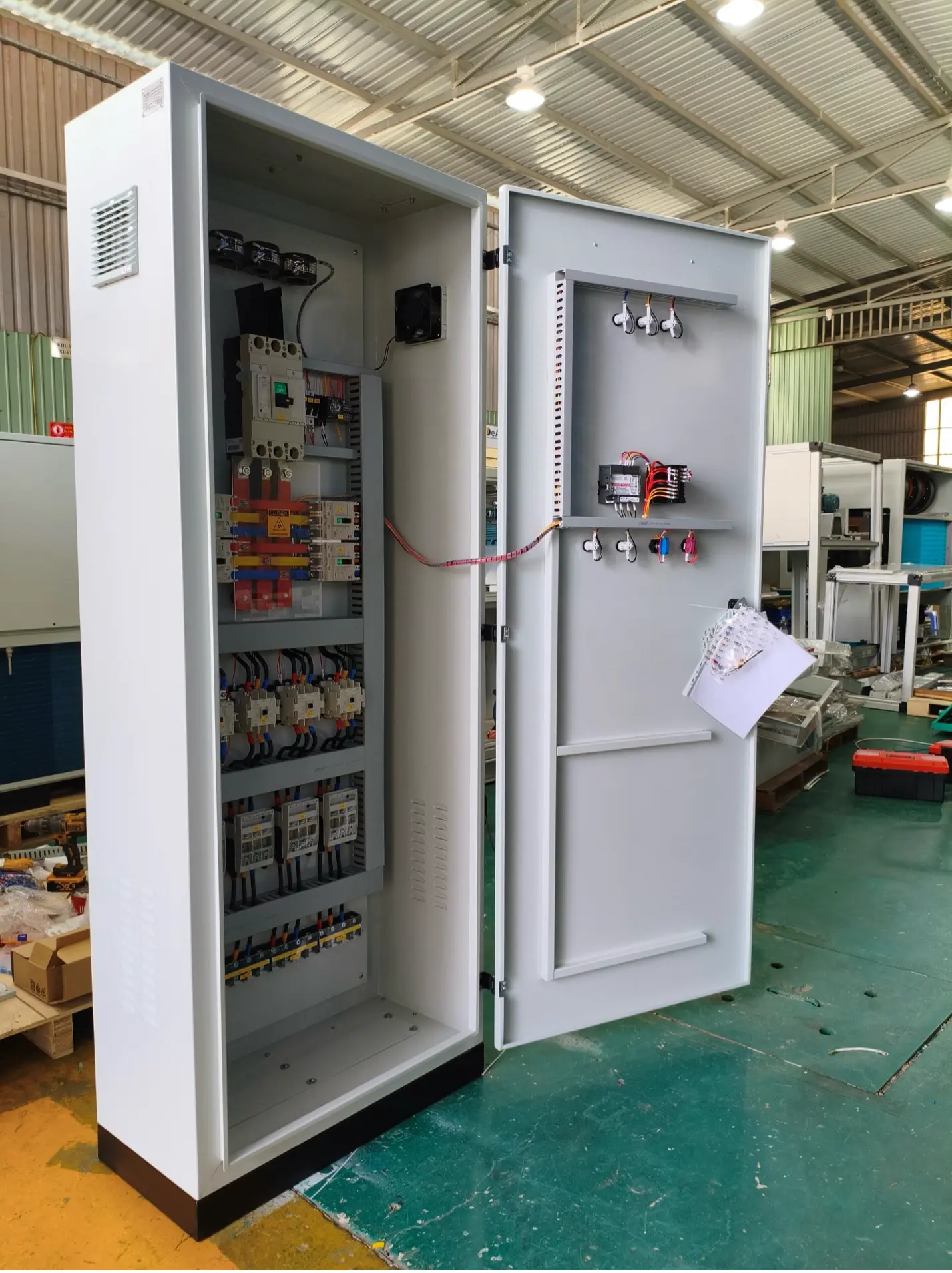




![[Case Study] DeAir Installs DeAir.De Rotor Humidity Control System for Pharmaceutical Plant in Binh Duong](https://deair.com.vn/thumbs/news/2023_04/ban_giao_may_cho_duoc_bd/[270x153-cr]image1-1024x772.jpg__cv.webp "[Case Study] DeAir Installs DeAir.De Rotor Humidity Control System for Pharmaceutical Plant in Binh Duong")

![[Review & Guide] Olmas OS-300: The New Humidity Control "Warrior" for Medium to Large Warehouses](https://deair.com.vn/thumbs/news/huong_dan_su_dung_may_olmas_21/[270x153-cr]vtm06440.png "[Review & Guide] Olmas OS-300: The New Humidity Control \"Warrior\" for Medium to Large Warehouses")