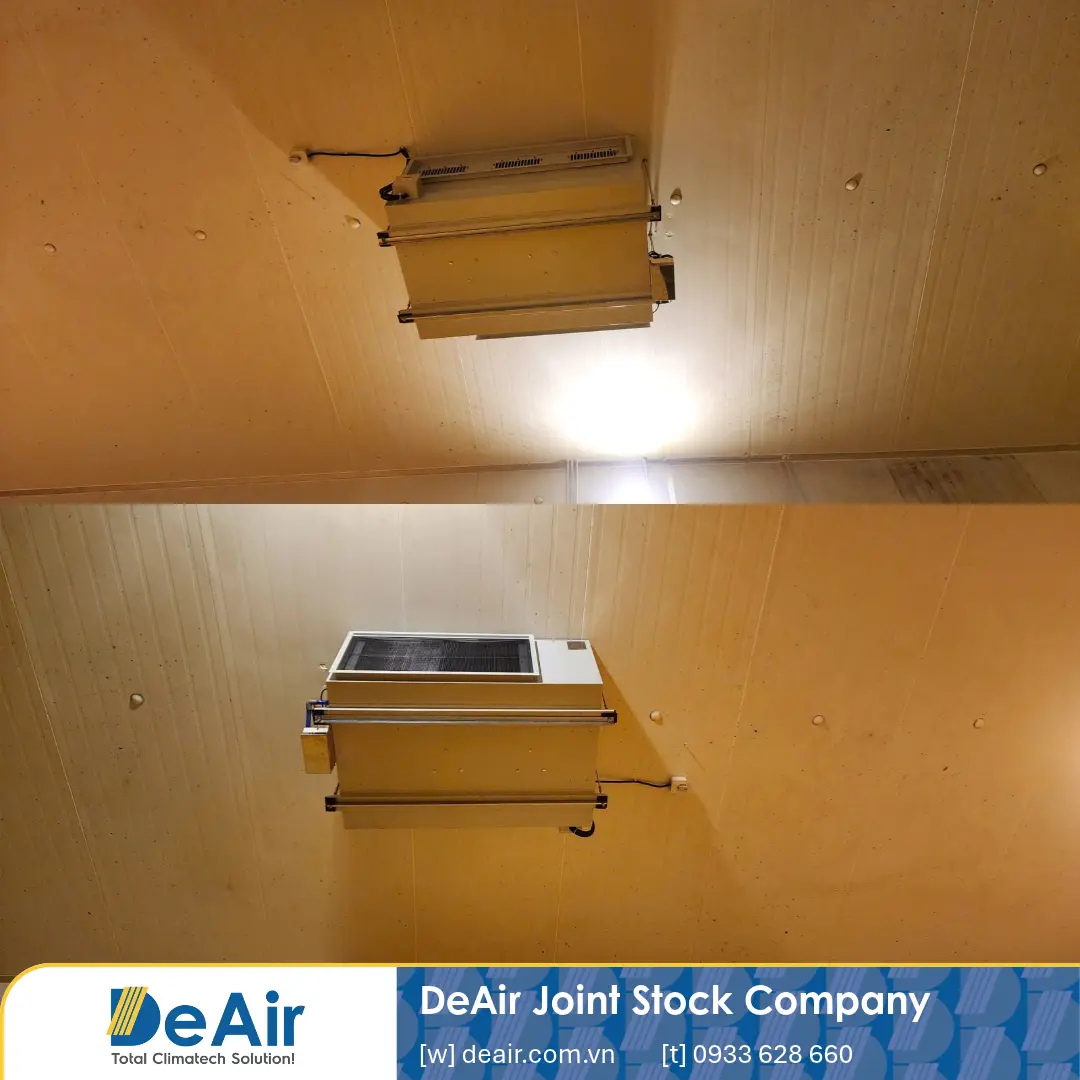
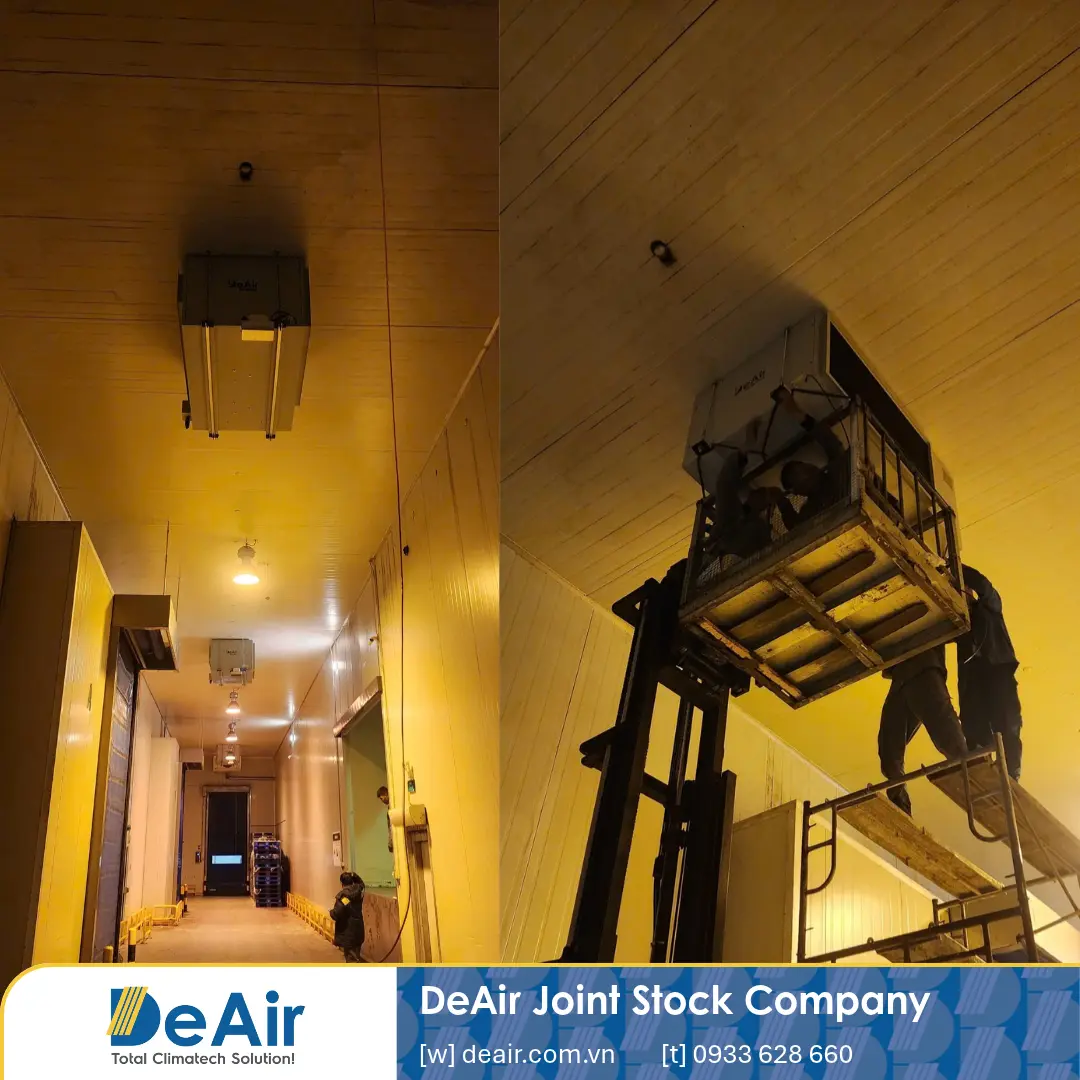
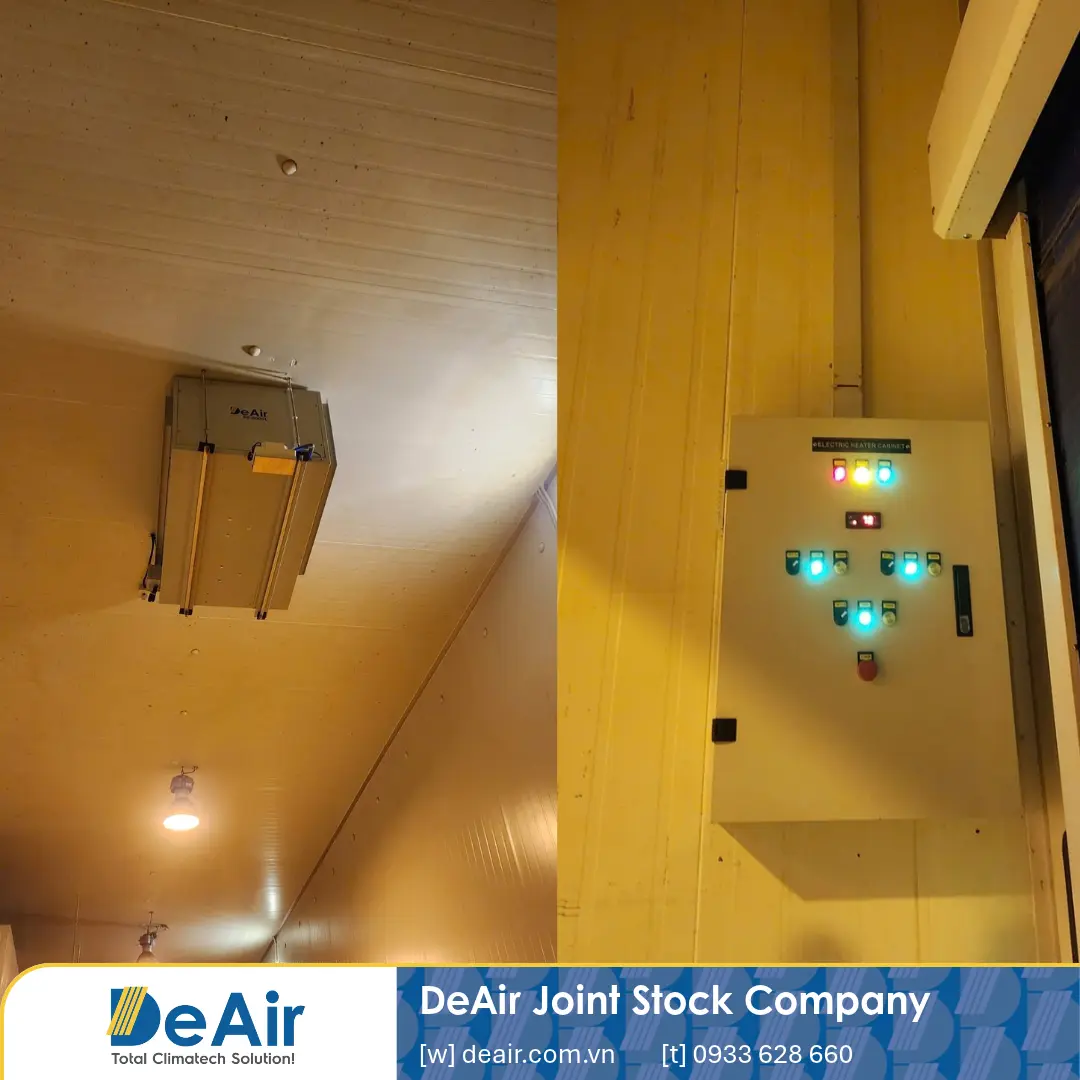
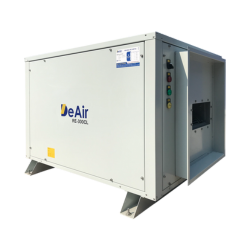
Machine mounted flush against the cold storage panel ceiling, completely freeing up floor space.
Condensate drainage pipe connected through the wall, routed outside the warehouse.
All units centrally controlled via a ground-level control cabinet for convenient operation and maintenance.
Results: Stable humidity control, reduced evaporator icing, enhanced safety for forklifts and products, and optimized warehouse area.
1. Cold Storage Challenges: Why Dehumidify from Above?
1.1. Classic Cold Storage Problems
🚨 FOUR COMMON PHENOMENA IN COLD STORAGE
Moisture infiltration: Every time loading dock doors open, humid air rushes in, causing fogging and condensation on ceilings and walls.
Evaporator icing: Moisture adheres to evaporator coils, reducing heat exchange efficiency by 30-50%, increasing defrost cycles and electricity consumption.
"Snowfall inside the warehouse": Ice falling from evaporators onto products – a serious food safety hazard.
Water accumulation and ice formation on floors: Creates slip hazards, workplace accidents for personnel and forklifts, increasing product damage risks.
1.2. Physics Principle: Moisture Rises Upward
Humid air has a lower specific weight than cold dry air, so it naturally accumulates near the warehouse ceiling. This is why floor-standing dehumidifiers struggle to "capture" moisture at ceiling level – where humidity is most concentrated. Mounting the dehumidifier overhead allows the unit to process moisture right at its "source," delivering superior efficiency compared to traditional floor-standing methods.
1.3. Why is the Ceiling-Mounted Solution Superior?
100% floor space freed: Cold storage floor space carries high value (calculated per pallet). Floor-standing units consume space, obstruct forklift pathways, and reduce pallet storage capacity.
Uniform dry air distribution: Blows dry air downward, creating a convection flow enveloping the entire cargo, avoiding humidity "dead zones" behind shelving units.
Prevents mechanical collisions: Forklifts operating in narrow cold storage aisles are prone to colliding with floor-standing units, causing damage.
Electrical safety: Electrical equipment mounted overhead avoids contact with floor water accumulation and cleaning environments.
2. Recommended Humidity Thresholds for Cold Storage
Based on the technical document "Recommended Temperature and Humidity Conditions by Environment" (DeAir's reference source), different zones within cold storage require maintaining the following thresholds:
📊 TEMPERATURE & HUMIDITY THRESHOLDS FOR COLD STORAGE
Area / Application
Temperature (°C)
Humidity (%RH)
Freezer tunnel anteroom
02 – 10°C
05 – 15%
Cold product receiving room
10 – 15°C
30 – 40%
Cold storage floor
10 – 15°C
30 – 40%
Refrigerated display cabinets
24°C
30 – 40%
* Source: "Recommended Temperature and Humidity Conditions by Environment" document – DeAir reference.
⚠️ IMPORTANT TECHNICAL NOTE FROM DEAIR
According to DeAir experts' recommendations, industrial dehumidifiers operating in environments between 15-18°C must be equipped with an additional defrost system for the dehumidification coil to operate effectively, avoiding localized icing that reduces performance. This is a technical detail that many installation contractors overlook when installing units for cold storage.
For warehouses requiring strict temperature control (no temperature increase allowed during dehumidification), DeAir recommends the isothermal DeAir.CRE series – a solution that controls humidity while virtually maintaining ambient temperature.
Cold storage panel ceilings (PU/PIR) have limited load-bearing capacity; a 200kg machine cannot be suspended directly from the panel. This is a technical challenge demanding experience and precise construction methodology.
🔧 DEAIR'S CONSTRUCTION SOLUTION
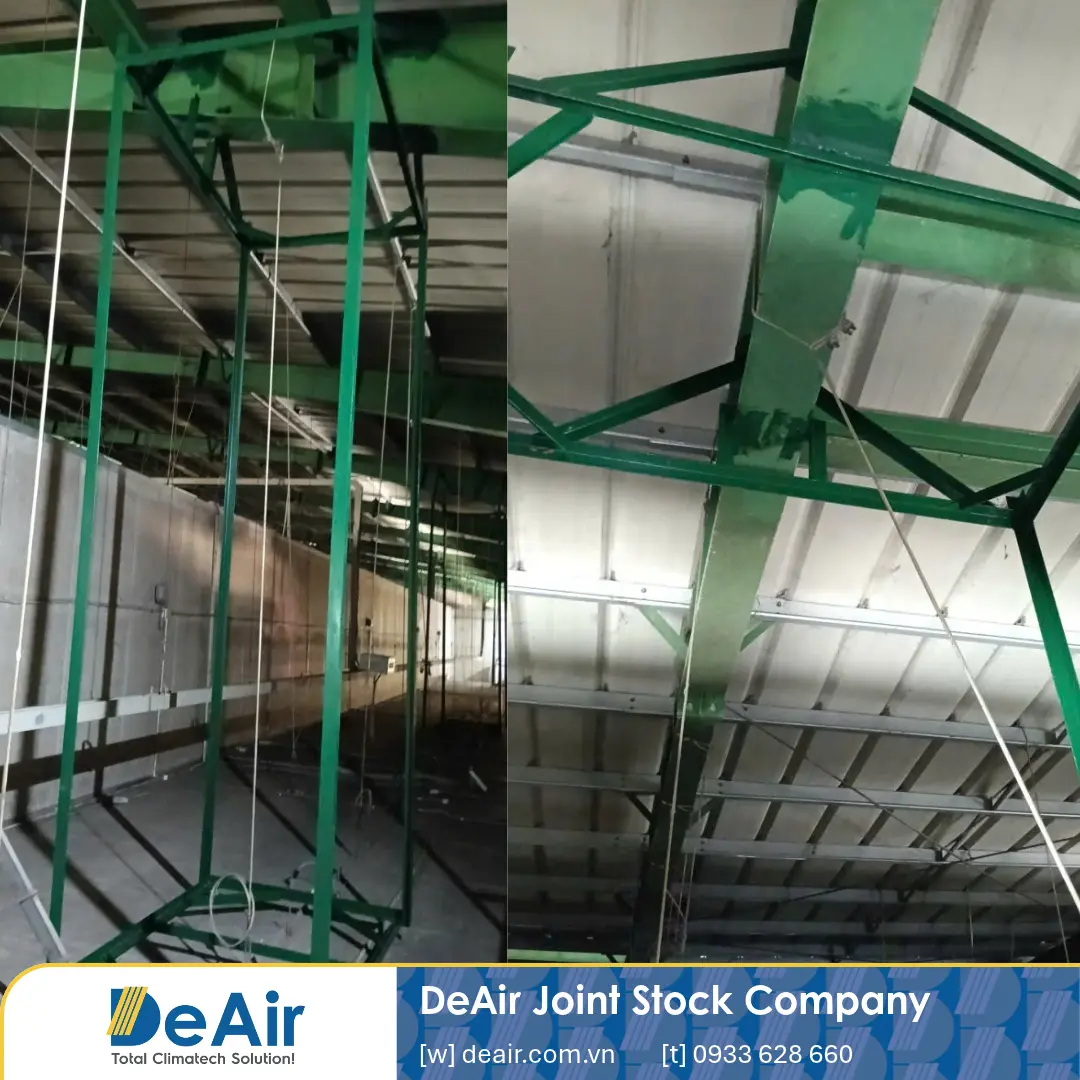
Heavy-duty support frame: Uses threaded rods and brackets connected directly to the warehouse's load-bearing steel structure (purlins, steel beams), distributing load evenly without deforming or piercing the panel.
Thermal bridge treatment: Panel penetration points are sealed with specialized sealant and insulation materials, preventing condensation at installation locations.
Installation height: Ensures adequate clearance for return air intake and supply air discharge per technical standards, while avoiding interference with forklift operations, lighting systems, and fire protection infrastructure.
3.2. Condensate Drainage Pipe Routed Outside the Warehouse
With a capacity of 600 kg/day, the machine generates approximately 25 liters of condensate per hour at rated conditions. Discharging inside the warehouse would cause water accumulation and floor icing – a serious safety hazard.
Wall penetration: The drainage pipe is led from the machine's collection tray, runs along the structure, and penetrates through the panel wall to the outside.
Continuous slope: Ensures water flows naturally by gravity, preventing horizontal pipe sections that could freeze in cold zones.
Waterproof sealing: Wall penetration points are sealed with insulation materials and waterproof sealant, preventing outside humid air from infiltrating.
External discharge point: Routed to a common drainage system or collection pit, preventing overflow and maintaining hygiene.
3.3. Centralized Control Cabinet at Ground Level
All control devices (contactors, relays, humidity controllers, indicator lights, emergency stop buttons) are integrated into a control cabinet positioned at a low, easily accessible location. This superior solution delivers multiple operational benefits:
Staff do not need to climb to height to turn on/off or set parameters.
Easy observation of machine operating status from a single point.
High electrical safety: cabinet located outside humid areas, offering better protection.
Convenient maintenance, repair, and component replacement without scaffolding.
Expandability: can integrate alternating operation of multiple machines, production shift scheduling, or signal connection to a central control room.
4. DeAir.RE-600CL Technical Specifications
Below are the baseline technical specifications of the DeAir.RE-600CL model applied to this project (data from DeAir's Company Profile):
📋 DEAIR.RE-600CL CEILING-MOUNTED DEHUMIDIFIER
Model
DeAir.RE-600CL
Operating Temperature
15 – 60°C
Dehumidification Capacity @30°C/70%
600 kg/day
Airflow
6,000 CMH
Noise Level
65 dBA (measured at 3m distance)
Refrigerant
R410A
Power Supply
380V / 3-Phase / 50Hz
Power Consumption
9 kW
Dimensions (W x D x H)
1,220 x 1,390 x 800 mm
Weight
200 kg
* For machines with capacity exceeding 150 L/day, ductwork length must be under 5m to ensure performance.
5. Overhead Installation Process
Structural Survey: Inspected load-bearing capacity of panel ceiling and warehouse steel frame, determined optimal hanging position for airflow.
Moisture Load Calculation: Based on warehouse volume, airtightness, door-opening frequency, and type of stored products.
Construction Drawing Design: Laid out machine position, supply/return duct routes, condensate drainage paths, control cabinet location, and electrical wiring.
Support Frame Fabrication: Manufactured support frames, threaded rods, and hanging brackets per drawings, ensuring load-bearing safety factors.
Overhead Machine Installation: Used specialized lifting equipment (man-lifts, hoists), strictly adhering to overhead work safety protocols.
Ductwork Installation: Installed supply/return ducts (if applicable), connected condensate drainage pipes through walls, sealed against thermal bridging.
Control Cabinet Installation & Wiring: Positioned the control cabinet conveniently, connected power and control wires from the cabinet to the machine.
Test Run & Calibration: Conducted trial operation, measured humidity at multiple warehouse points, verified condensate drainage flow, calibrated control parameters.
Handover & Training: Guided operation, filter cleaning, fault code reading; handed over as-built documentation and 24-month warranty certificate.
6. Real-World Project Images
Support frame and threaded rods connected to the load-bearing steel structure, evenly distributing load and ensuring structural safety.Condensate drainage pipe connected through the panel wall, sealed against water leakage and thermal bridging.
Centralized control cabinet positioned at a low level, convenient for operation and maintenance.
Effective humidity control: Humidity maintained stably at recommended thresholds, reducing fogging and condensation on ceilings and walls.
Cooling system protection: Reduced evaporator icing frequency, reduced defrost cycles, saving electricity for the refrigeration system.
Operational safety: Warehouse floor stays dry, no water accumulation, reduced slip hazards; ground-level control cabinet is easy to operate.
Easy maintenance: All operation and inspection tasks performed from the ground-level control cabinet, eliminating the need for frequent overhead access.
Q1: Is it safe to suspend a 200kg machine from a cold storage panel ceiling?
It is safe if executed with correct technical methodology. DeAir does not suspend the machine directly from the panel but connects the support frame to the warehouse's load-bearing steel structure (purlins, beams), distributing load evenly with high safety factors. The panel only serves as enclosure, not bearing the machine's weight.
Q2: Does the dehumidifier increase the temperature inside the cold storage?
The dehumidifier releases slight heat during operation. However, this amount is small compared to the warehouse's cooling capacity and is easily compensated. In return, benefits from reduced evaporator icing and defrost cycles help the refrigeration system operate more efficiently, saving electricity overall. For warehouses requiring strict temperature control, DeAir recommends the isothermal DeAir.CRE series – controlling humidity while virtually maintaining ambient temperature.
Q3: Will condensate water freeze in the drainage pipe when routed outside?
This is a real risk if constructed incorrectly. DeAir addresses this by ensuring a continuous slope for fast water flow, minimizing pipe sections within sub-zero temperature zones, and optionally applying insulation or heating cables for pipe sections passing through cold zones if necessary. Drainage is routed outside the warehouse, not left standing in cold areas.
Q4: Is maintaining a ceiling-mounted machine difficult?
Filter cleaning and periodic inspections require overhead access, but at low frequency (once every 1-3 months depending on environment). DeAir provides periodic maintenance services with complete lifting equipment and specialized personnel, so clients do not need to perform it themselves. Additionally, the ground-level control cabinet makes daily operational tasks easy to perform from the floor.
🏆 DEAIR COMMITMENTS
✅ Free structural survey and moisture load calculation before proposing solutions.
✅ Overhead installation strictly adhering to workplace safety regulations.
✅ Standardized service processes per ISO 9001:2015 quality management system.
✅ 24-month warranty from delivery date, covering parts and labor costs for manufacturer defects.
✅ Nationwide technical team, manufacturing facility in Ho Chi Minh City, branch and service center in Hung Yen.
Every Square Meter of Cold Storage Floor Is Valuable. Don't Waste It!
Let DeAir elevate dehumidification to the ceiling – where it delivers maximum effectiveness. Free up floor space, protect products, optimize operational costs.
Contact us now for a free site survey and consultation!


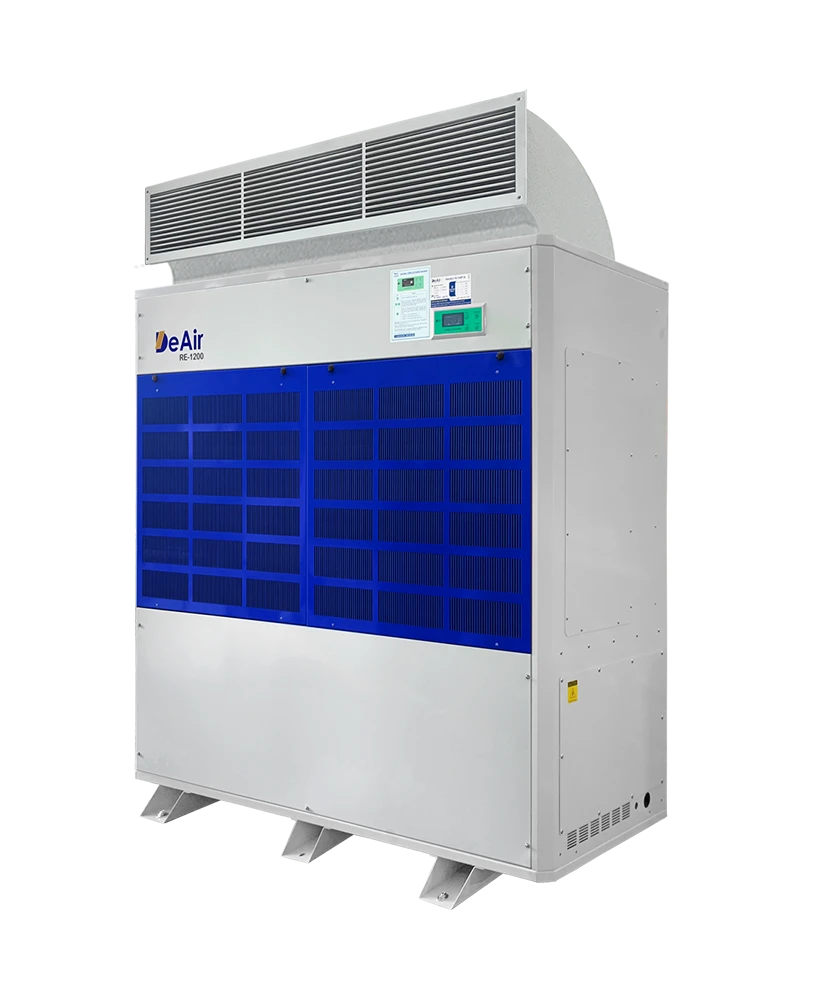 DeAir.RE
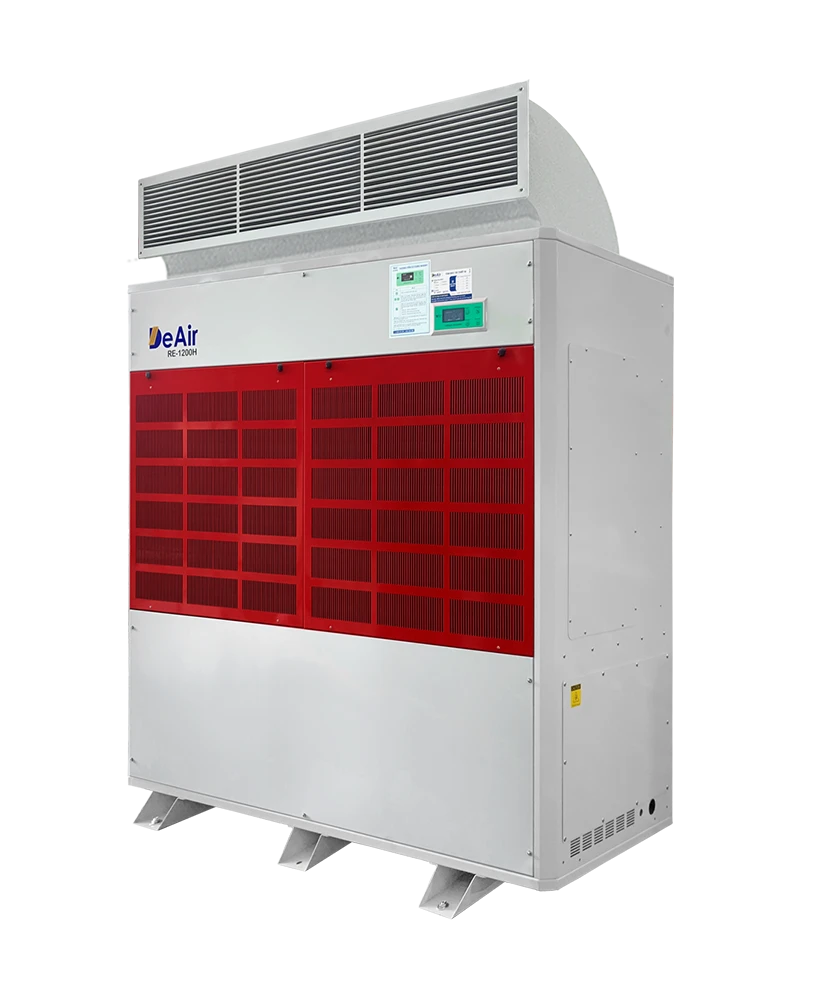 DeAir.RE-H
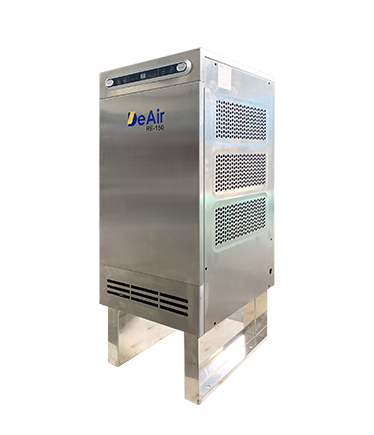 DeAir.RE-INOX
 DeAir.CRE
 Dezenno
 DeAir.RE-CL
 Olmas-OS
 DeAir.HM
 Daxwell
 DeAir.Heat
 AHU
 DeAir.CUSTOM