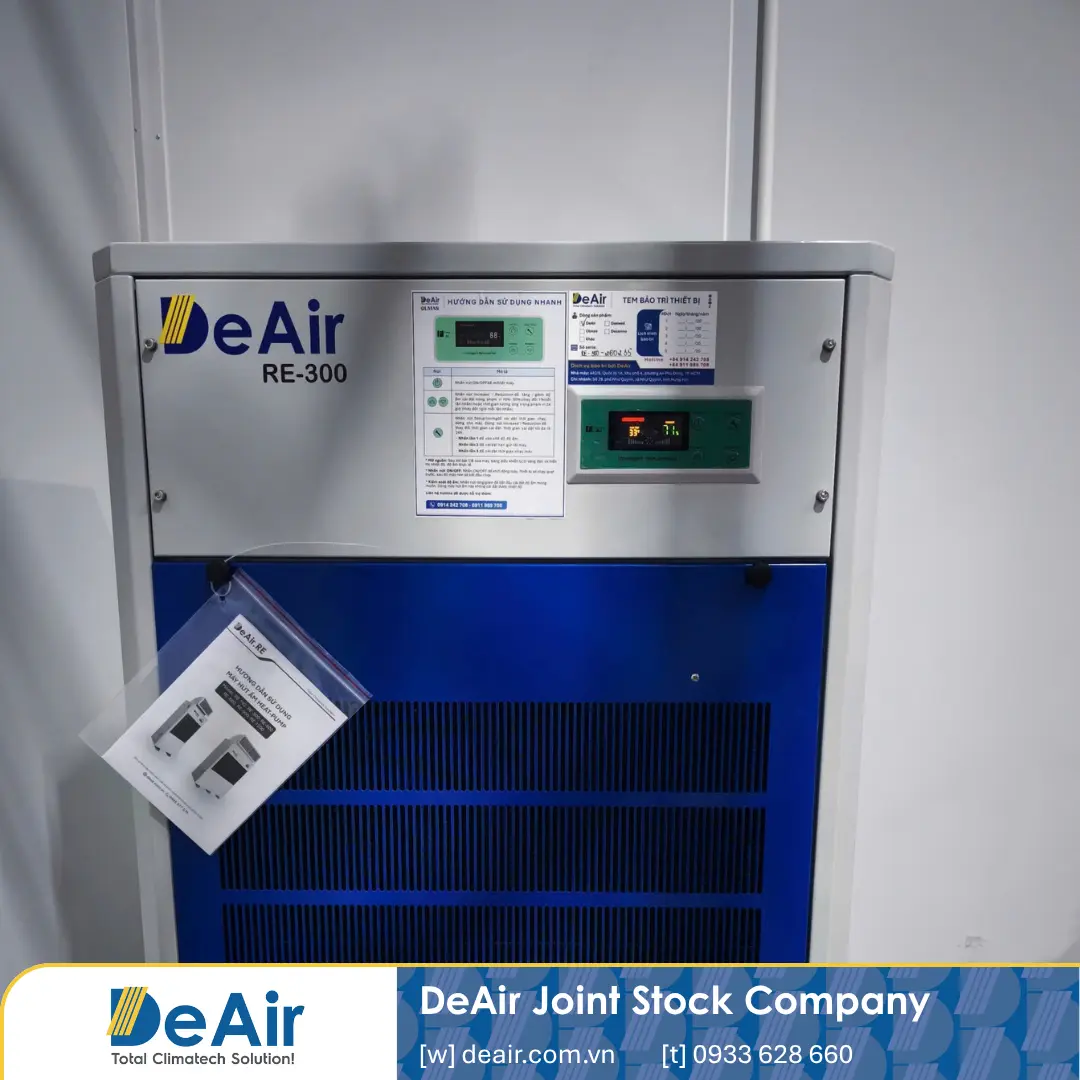
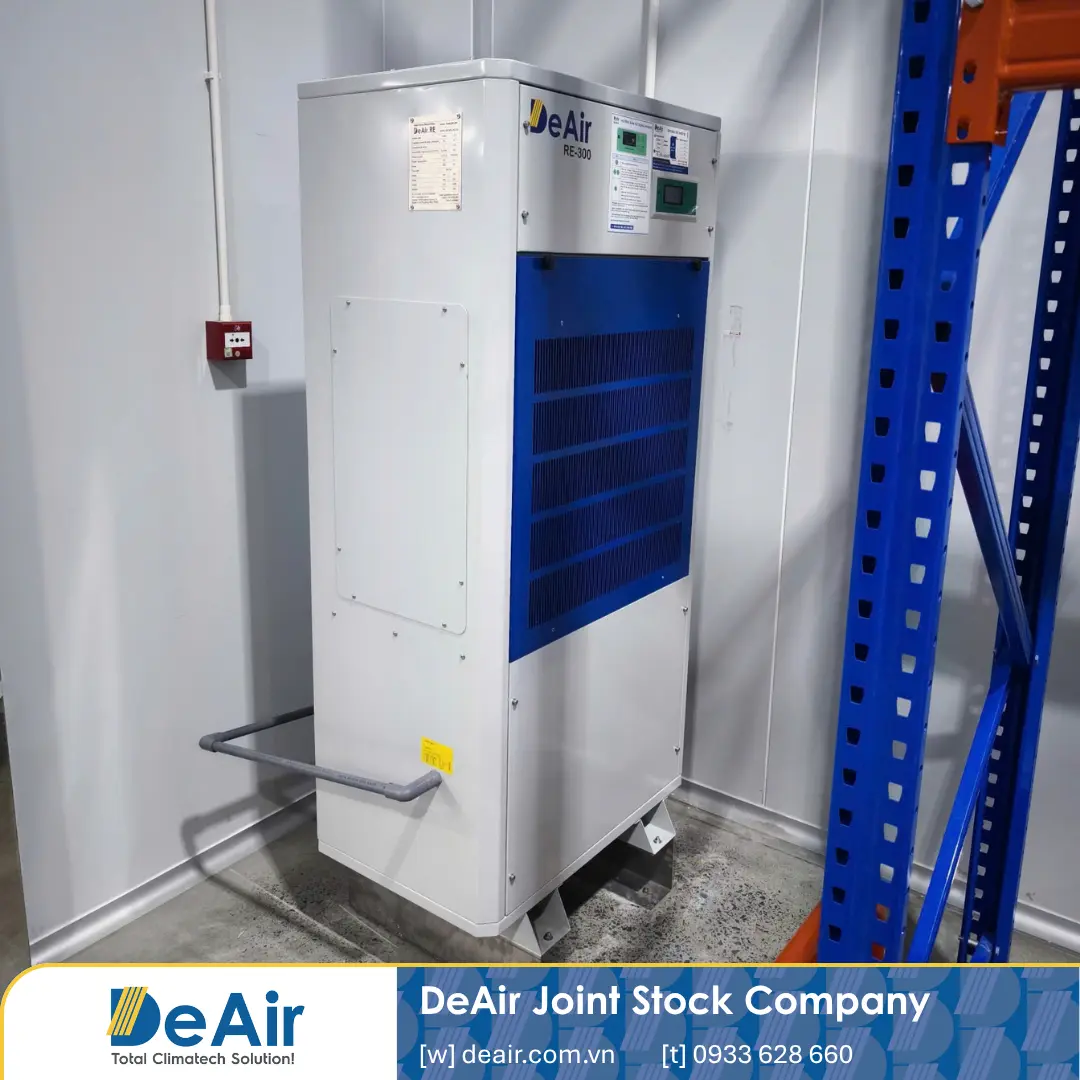
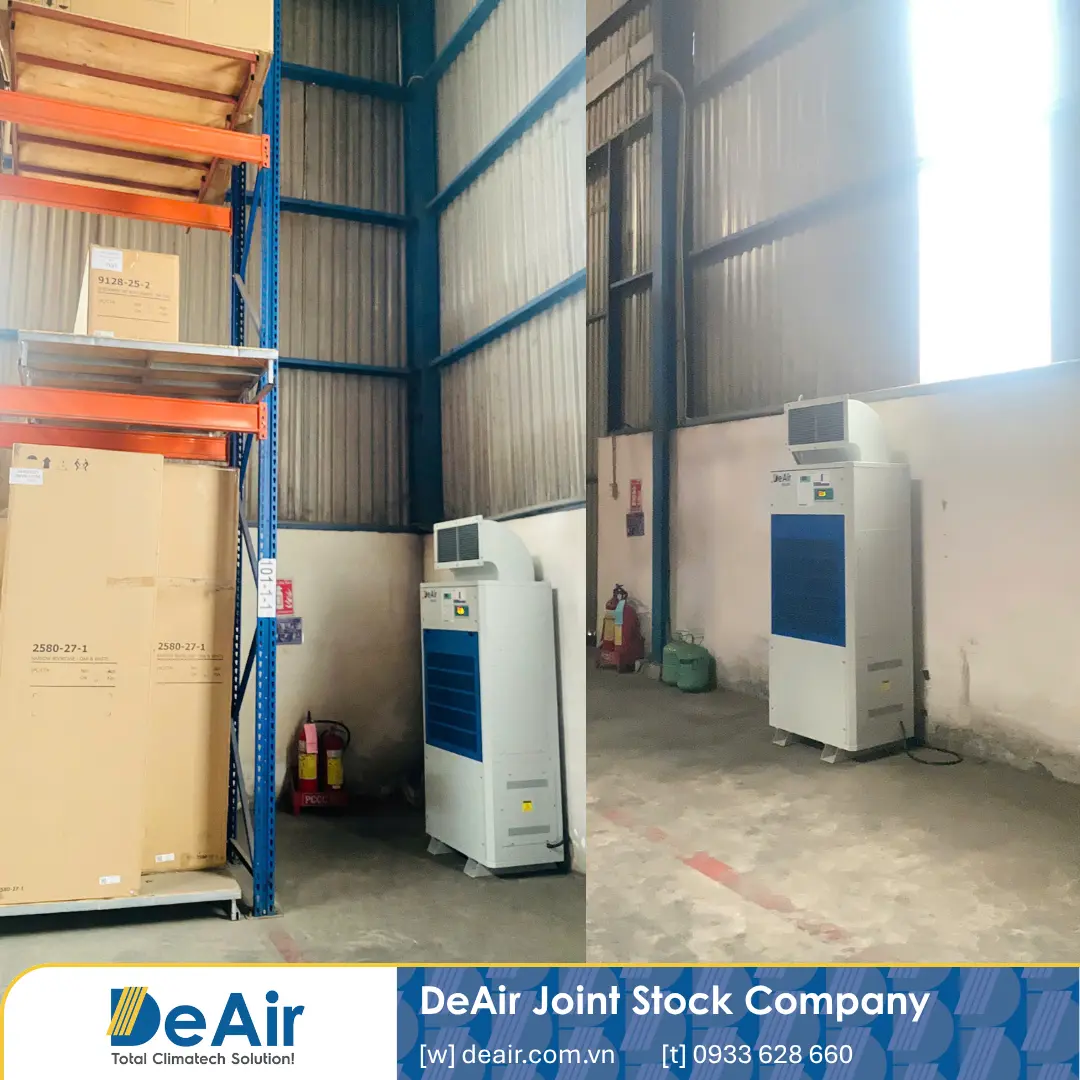
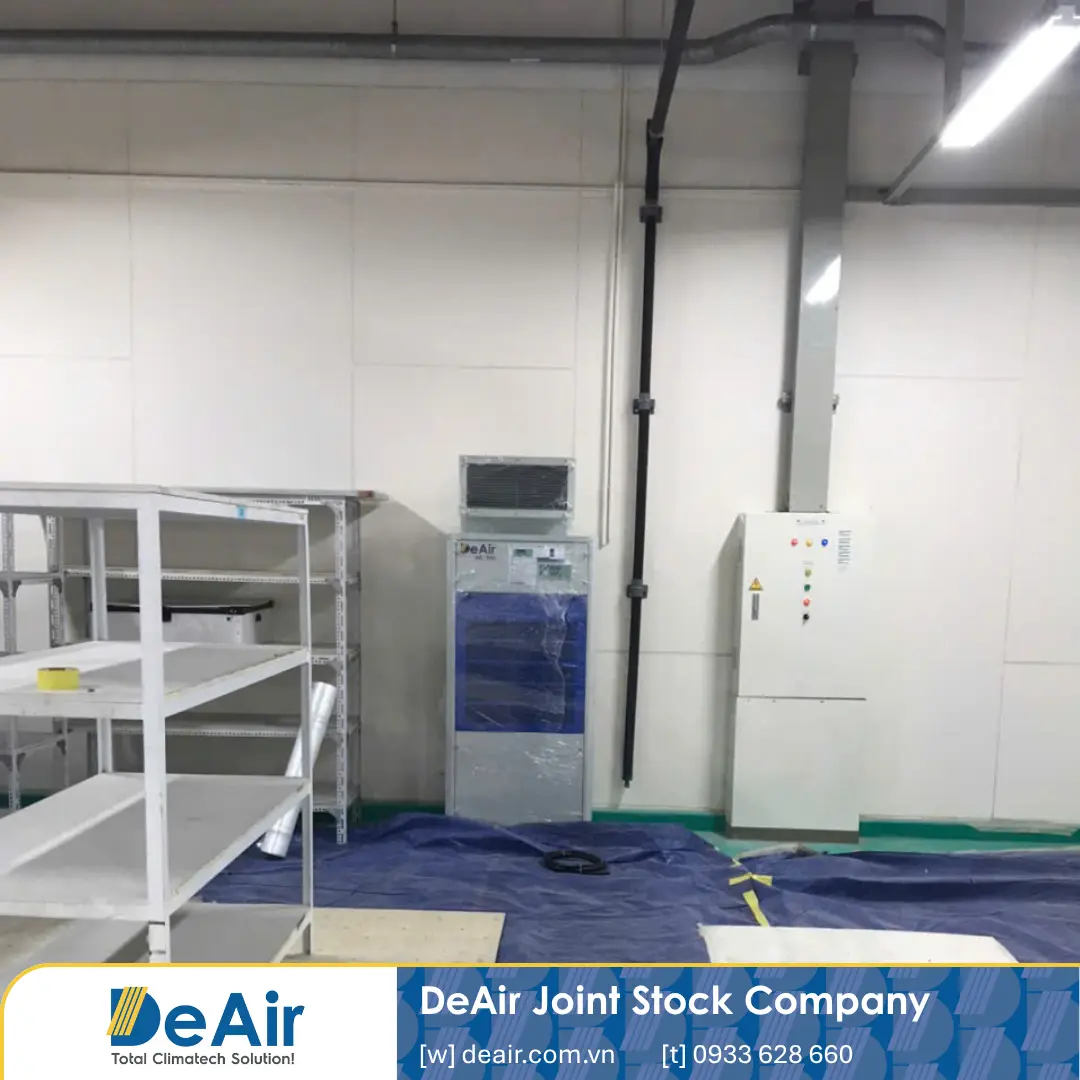
The DeAir.RE-300 industrial dehumidifier installed in a food raw material storage room.
💡 Executive Summary
Client: A food processing company in Northern Vietnam (preparing for the peak production season).
Challenge: Heavy rain alternating with intense sunshine keeps humidity constantly at 85-95% RH, combined with the imminent threat of the Northern "Nồm" season (humidity >95% RH, severe condensation).
Solution: Installation of the DeAir.RE-300 heat-pump dehumidifier for the raw material storage room.
Result: Precise humidity control according to each raw material's standard, protecting quality, extending shelf life, and saving 50% on energy.
1. Harsh Weather Context & Challenges for the Food Industry
1.1. The Current "Unpredictable" Weather
Northern Vietnam is experiencing an extremely uncomfortable weather period with prolonged heavy rain alternating with intense sunshine, creating major challenges for food raw material storage:
Highly fluctuating air humidity: Ranging from 75-95% RH within a single day.
Hot, humid air infiltration: Every time the warehouse door is opened for loading/unloading.
Surface condensation: Moisture accumulating on packaging, warehouse walls, and floors.
Difficult to control: Rapid weather changes render passive solutions ineffective.
1.2. Preparing for the Northern "Nồm" Season (January - March Next Year)
⚠️ THE "NỒM" SEASON CONCERNS
Severe condensation: On every surface (floors, walls, packaging, machinery).
Humidity consistently exceeds 95% RH: Lasting for weeks at a time.
Rapid mold growth: Especially on organic raw materials (flour, grains, spices).
Extended duration: From January to March every year, causing massive losses if not prepared in advance.
1.3. Current Damage Status in the Food Industry
Many food enterprises have lost hundreds of millions to billions of VND in raw materials due to mold, caking, and degradation when humidity is not properly controlled. High-value raw materials such as imported spices, medicinal herbs, milk powder, and premium tea are the most heavily affected.
2. Serious Consequences When Humidity Exceeds Thresholds in Raw Material Warehouses
2.1. Physical & Chemical Damage
🚨 DAMAGE PHENOMENA
Powders (flour, milk powder, spice powder): Caking, loss of fluffiness, difficult to measure during blending.
Sugar and salt: Deliquescence, clumping, reduced quality, difficult to use.
Grains and seeds: Mold, germination, loss of nutritional value.
Dried ingredients (dried vegetables, dried fish, tea): Re-absorb moisture, lose crispiness, changes in color and flavor.
Chocolate: "Fat bloom" and "sugar bloom" phenomena due to humidity fluctuations.
2.2. Microorganism Development
🦠 MICROBIAL RISKS
Mold (Aspergillus, Penicillium): Produces dangerous aflatoxin toxins, especially on grains and seeds. This is the greatest health hazard to consumers.
Bacteria: Proliferate rapidly at humidity >70% RH, spoiling food and shortening shelf life.
Insects and pests: Damp environments provide ideal conditions for breeding and destroying raw materials.
2.3. Economic & Reputational Damage
Total loss of expensive raw materials: Imported spices, medicinal herbs, premium milk powder.
Production interruptions: Due to a lack of qualified raw materials, affecting order timelines.
Product recall risks: Severely impacting brand reputation in the market.
Incident handling costs: Lot destruction, re-testing, contract compensation.
3. Why DeAir.RE-300 is the Perfect "Shield" for Raw Material Storage?
The DeAir.RE-300 is placed at an optimal location in the raw material room, ensuring uniform air circulation.
3.1. Suitable Technical Specifications
📋 DEAIR.RE-300 TECHNICAL SPECIFICATIONS
Operating temperature: (15 - 60)°C – Effective in both the cold "Nồm" season (15-20°C) and hot summer.
Airflow: 3,000 CMH – Ensures even air circulation throughout the warehouse.
Dehumidification capacity: 300 kg/day – Suitable for raw material rooms of 150-300 m².
Rating conditions: 30°C, 70% RH.
Power consumption: 4.6 kW – Low electricity consumption thanks to Heat-Pump technology.
High efficiency at low temperatures: Still maintains strong dehumidification at 15-20°C ("Nồm" season), while conventional condensation units lose 50-70% efficiency.
Does not chill the room: The discharged air is slightly warm, protecting raw materials sensitive to thermal shock.
Stable year-round operation: Whether it's the "Nồm" season or hot, humid summer.
3.3. Specialized Design for Food Warehouses
Powder-coated housing: Corrosion-resistant, easy to clean, meets HACCP/GMP standards of the food industry.
F5 air filter: Protects the heat exchanger from powder and spice dust – typical characteristics of food raw material warehouses.
Automatic condensate drainage: No water tank needed, operates 24/7 without manual intervention.
Automatic control: Set target humidity, the machine automatically starts/stops according to demand, with intelligent fault alerts.
4. The "Golden" Humidity Thresholds for Each Type of Food Raw Material
Based on the document "Recommended Temperature and Humidity Conditions by Environment", DeAir has advised the client on optimal humidity thresholds for each type of raw material:
📊 TEMPERATURE & HUMIDITY THRESHOLDS BY STANDARD
Raw Material Type
Temperature (°C)
Humidity (RH%)
Risk When Exceeded
Wheat flour, rice flour
16-32°C
45-50%
Caking, mold
Sugar
24°C
20-30%
Deliquescence, clumping
Grains and seeds
15°C
40%
Germination, aflatoxin
Milk powder
21-26°C
15-30%
Caking, quality loss
Spices, herbs
15°C
30%
Loss of aroma, mold
Dried vegetables
2-22°C
40-45%
Re-hydration, softening
Dried fish, dried seafood
15-20°C
25-30%
Mold, rancidity
Tea, coffee
20-29°C
35-60%
Loss of flavor, moisture
Chocolate
16-18°C
45%
Fat bloom, sugar bloom
Instant noodles, fast food
25°C
40%
Softening, oil rancidity
* Source: "Recommended Temperature and Humidity Conditions by Environment" document – DeAir
5. Professional Handover & Installation Process
Step 1: Survey & Moisture Load Calculation
DeAir's engineering team conducts a detailed survey: measuring the warehouse volume, evaluating airtightness, identifying moisture infiltration sources (doors, packaging, walls, floors), and calculating the appropriate machine capacity for each specific raw material.
Step 2: Optimal Installation Location Consulting
The machine is placed in a central location to ensure uniform air circulation throughout the warehouse, avoiding placement near doors and heat sources. Circulation fans are combined if the warehouse has many racks or partitions to avoid humidity "dead spots".
DeAir.RE-300 installed at a strategic location in the warehouse.DeAir.RE-300 operating stably in the raw material warehouse.
Step 3: Installation & Connection
DeAir technicians wire the electrical connections safely according to the 380V/3-phase/50Hz standard, professionally install the condensate drainage pipe, and configure technical parameters on the PLC/HMI control panel. Special attention is paid to correctly connecting the 3-phase power supply to ensure stable machine operation at 4.6 kW.
Step 4: Test Run & Operational Training
Continuous 24-hour test runs are conducted, with actual humidity measurements taken at multiple locations in the warehouse to ensure uniformity. Detailed training is provided to warehouse staff on operation, filter cleaning, and fault alert interpretation. Technical documents and a 24-month genuine warranty certificate are handed over.
6. DeAir.RE-300 Dehumidifier Introduction Video
Explore the details of the DeAir.RE-300 heat-pump dehumidifier series through DeAir's introduction videos:
Short video: Overview of the DeAir.RE-300Detailed video: Operation and maintenance guide
7. Achieved Results After DeAir.RE-300 Installation
✅ OUTSTANDING RESULTS
Quality: Warehouse humidity is stable at 30-50% RH (depending on the raw material), with no more caking, mold, or degradation.
Economics: 90% reduction in raw material spoilage rate, 50% savings on electricity costs compared to conventional condensation units.
Operations: 24/7 automated system, no manual intervention required, peace of mind when loading/unloading raw materials.
Future: Ready to face the Northern Vietnam "Nồm" season, protecting assets worth billions of VND.
8. Frequently Asked Questions (FAQ)
Q1: During the Northern "Nồm" season when humidity >95% RH, can the DeAir.RE-300 cope?
YES. The DeAir.RE-300 uses Heat-Pump technology, maintaining high dehumidification efficiency even at low temperatures of 15-20°C – something conventional condensation units cannot do. With a capacity of 300 kg/day, the machine fully meets the needs of warehouses from 150-300 m² even in the harshest "Nồm" season conditions in Northern Vietnam.
Q2: Food warehouses need to meet hygiene standards; is the machine suitable?
Absolutely suitable. The DeAir.RE-300 has a powder-coated housing, is easy to clean, and does not emit dust or odors. The F5 air filter prevents dust from entering the heat exchanger, fully meeting the stringent HACCP/GMP standards of the food industry.
Q3: Can the machine operate 24/7? Does it consume a lot of electricity?
The machine is designed to operate continuously 24/7 with an automatic condensate drainage system, requiring no water tank or manual intervention. Thanks to Heat-Pump technology, the machine saves 40-50% of electricity compared to conventional condensation units, significantly reducing warehouse operating costs – a crucial factor when the machine must run continuously during the "Nồm" season.
Q4: Does DeAir offer periodic maintenance support for food warehouses?
YES. DeAir offers a periodic maintenance package every 6 months, including heat exchanger cleaning, refrigeration system checks, sensor calibration, and air filter inspection. The technical team is on-site within 24 hours in case of an incident, ensuring the system always operates stably to protect your raw materials worth billions of VND.
Don't Let the "Nồm" Season "Wipe Out" Your Raw Material Warehouse!
Let DeAir protect your assets worth billions of VND with an energy-saving heat-pump solution, preparing for the upcoming Northern Vietnam "Nồm" season.
Contact us now for a free survey and consultation!


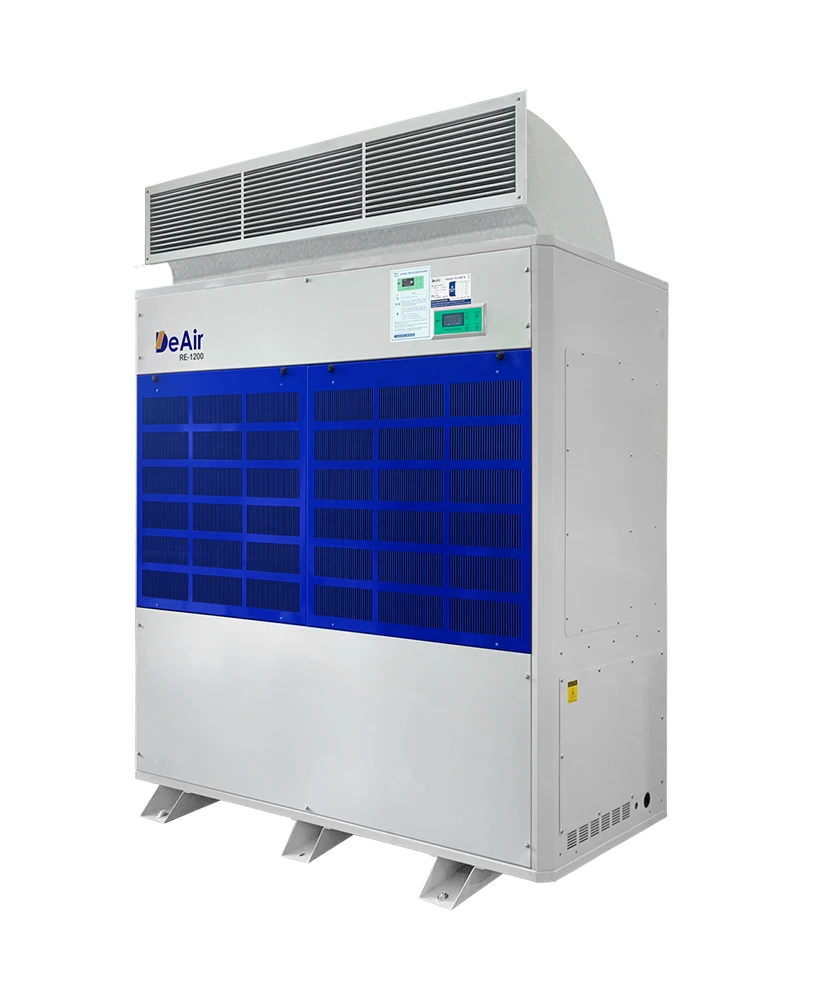 DeAir.RE
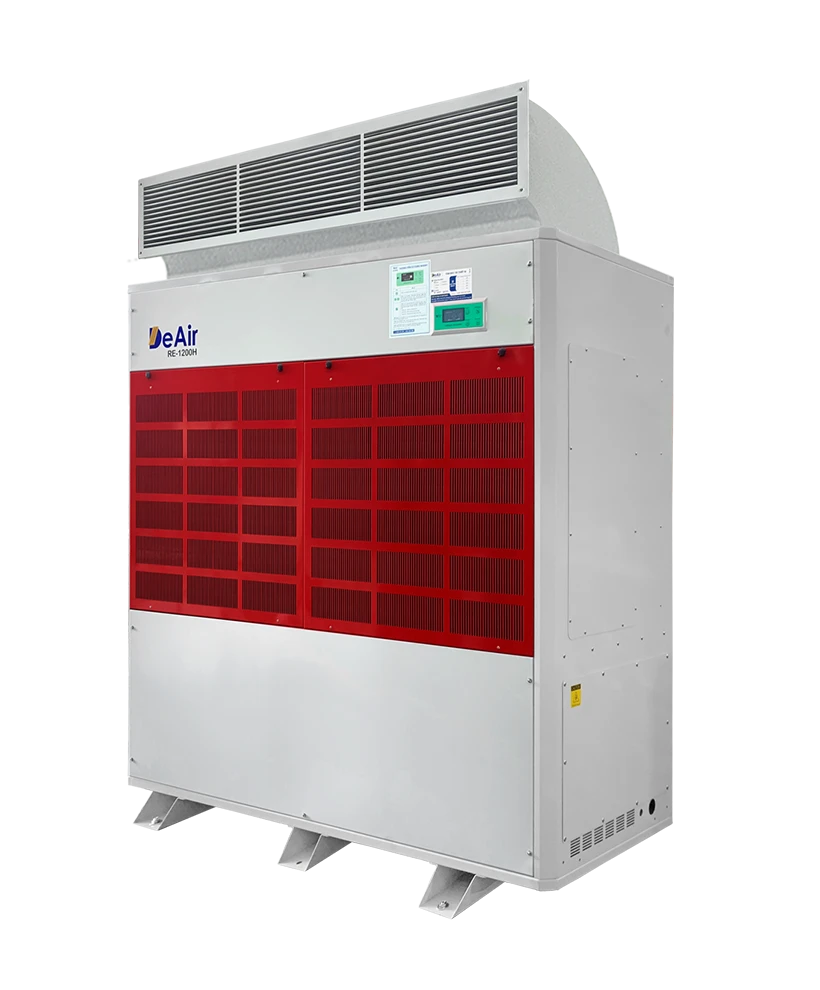 DeAir.RE-H
 DeAir.RE-INOX
 DeAir.CRE
 Dezenno
 DeAir.RE-CL
 Olmas-OS
 DeAir.HM
 Daxwell
 DeAir.Heat
 AHU
AHU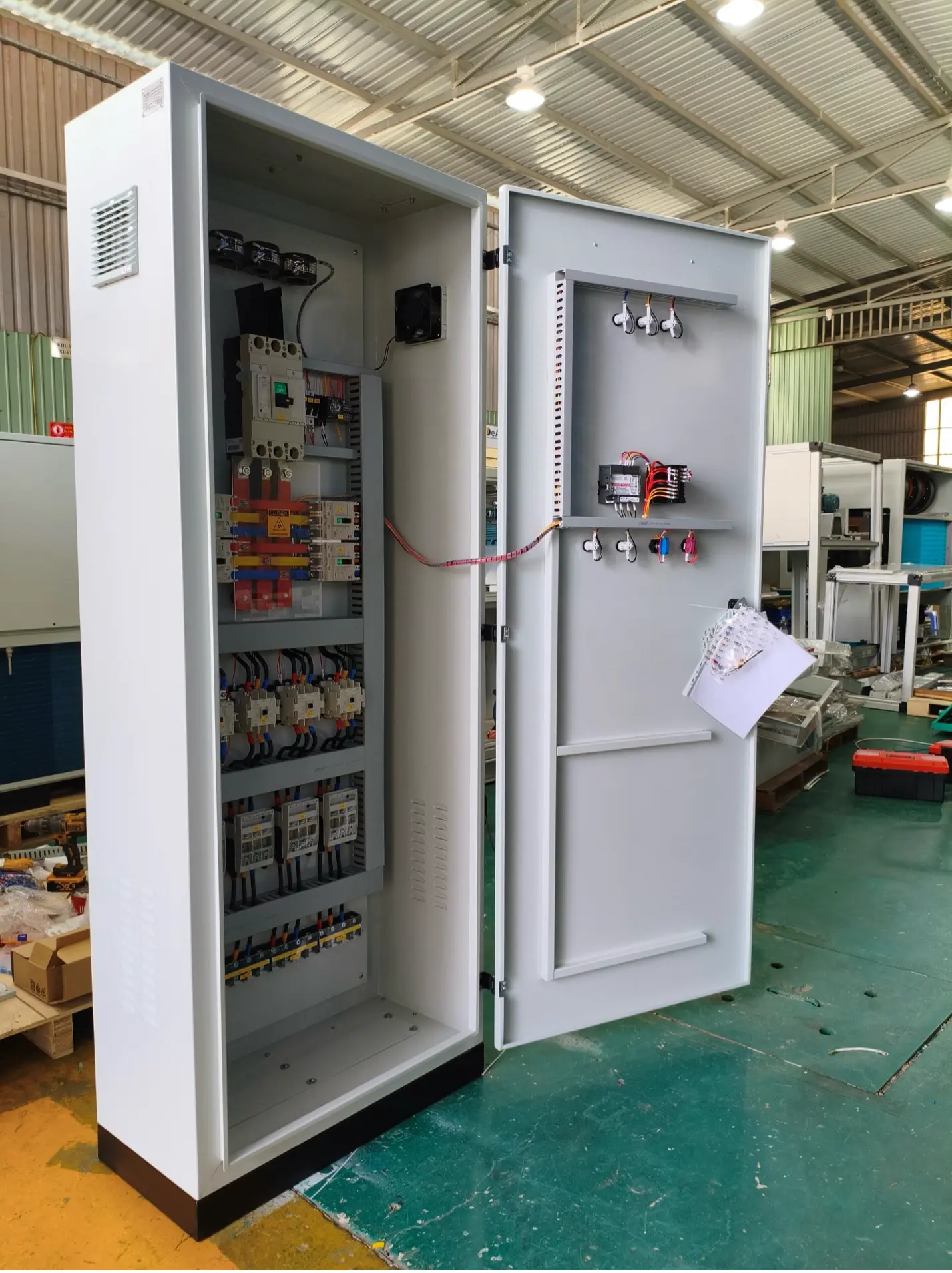






![[Case Study] DeAir Installs DeAir.De Rotor Humidity Control System for Pharmaceutical Plant in Binh Duong](https://deair.com.vn/thumbs/news/2023_04/ban_giao_may_cho_duoc_bd/[270x153-cr]image1-1024x772.jpg__cv.webp "[Case Study] DeAir Installs DeAir.De Rotor Humidity Control System for Pharmaceutical Plant in Binh Duong")
![[Review & Guide] Olmas OS-300: The New Humidity Control "Warrior" for Medium to Large Warehouses](https://deair.com.vn/thumbs/news/huong_dan_su_dung_may_olmas_21/[270x153-cr]vtm06440.png "[Review & Guide] Olmas OS-300: The New Humidity Control \"Warrior\" for Medium to Large Warehouses")