Context: An electronic ceramic components factory in Hung Yen required a humidity control solution for raw material and finished goods storage.
Challenge: Electronic ceramics are extremely sensitive to moisture. High humidity alters dielectric properties and causes cracking during the sintering process.
Solution: Installation of the DeAir.RE-300 heat-pump dehumidifier (300 kg/day capacity), providing precise humidity control at 35-45% RH.
Result: A stable storage environment, protection of ceramic component quality, and 50% energy savings compared to traditional solutions.
1. Specifics of Electronic Ceramics and Humidity Control Requirements
1.1. Why is Humidity the "Enemy" of Electronic Ceramics?
Electronic ceramic components, including Multi-Layer Ceramic Capacitors (MLCCs), piezoelectric ceramics, and ferrites, have a porous micro-structure that readily absorbs ambient moisture. This leads to severe technical consequences:
⚠️ TECHNICAL RISKS
Altered dielectric properties: Moisture absorption changes the dielectric constant, directly impacting the performance and accuracy of ceramic capacitors.
Cracking during sintering: Trapped moisture vaporizes rapidly at high temperatures (1000-1500°C), creating internal pressure that causes the components to crack or shatter (the "popcorn" effect).
Reduced mechanical strength: Humidity weakens molecular bonds, reducing the flexural and compressive strength of green ceramics.
1.2. Strict Humidity Standards
Based on international standards and practical application experience, storing electronic components and ceramics requires strictly controlled environments. Technical recommendations dictate that electronic component storage should be maintained at around 35% RH (at 22°C), while ceramic storage requires humidity levels between 15-50% RH (at 16-27°C).
DeAir engineers conducted a detailed on-site survey of the warehouse in Hung Yen: measuring volume, evaluating panel wall airtightness, and categorizing the specific types of electronic ceramics stored to accurately calculate the moisture load and propose optimal installation positions.
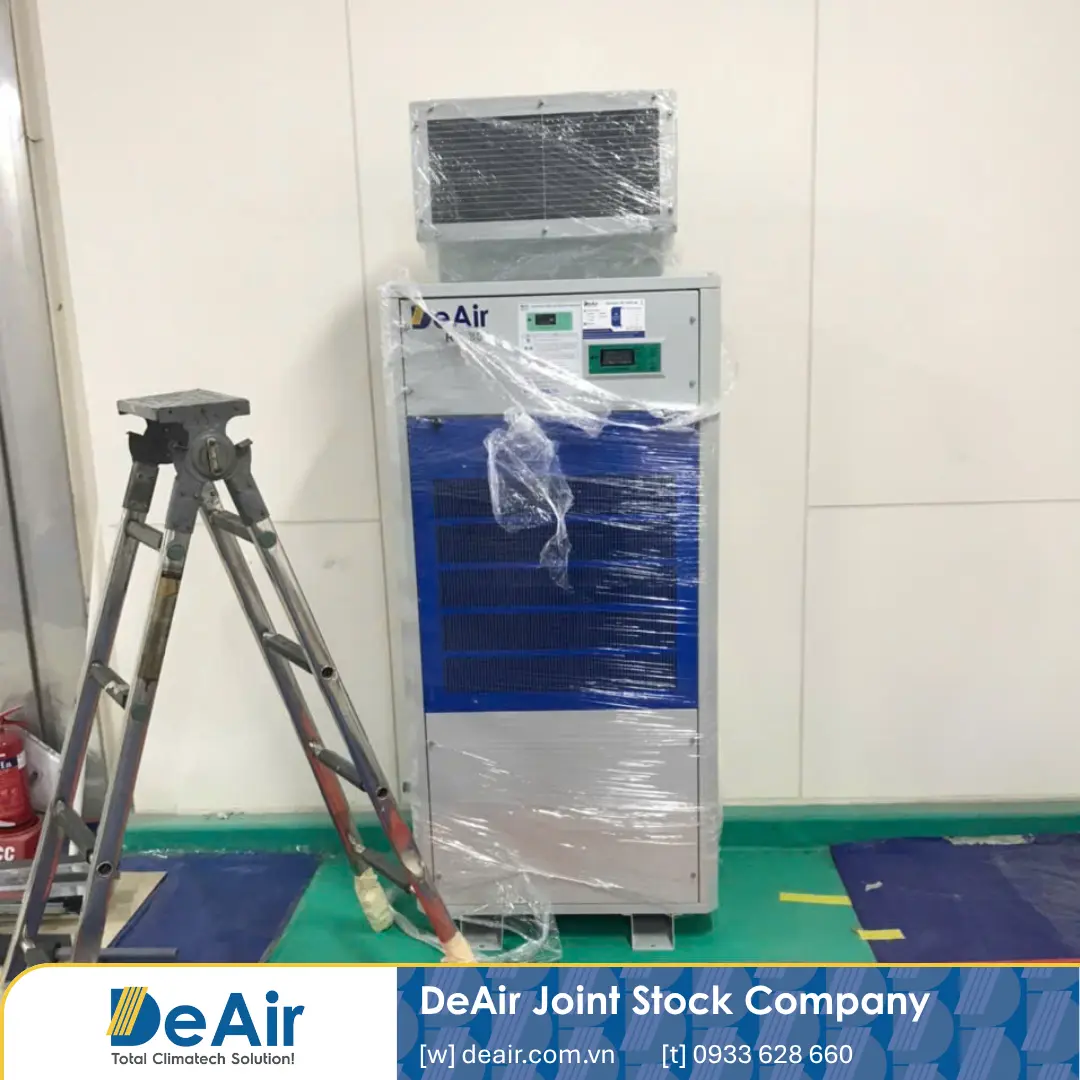
3.2. Transportation & Equipment Handover
The equipment was safely transported from the DeAir factory to the customer's warehouse. The handover process included a thorough visual inspection and confirmation of all accompanying accessories.
The DeAir.RE-300 dehumidifier safely transported and handed over, ensuring top quality prior to installation.
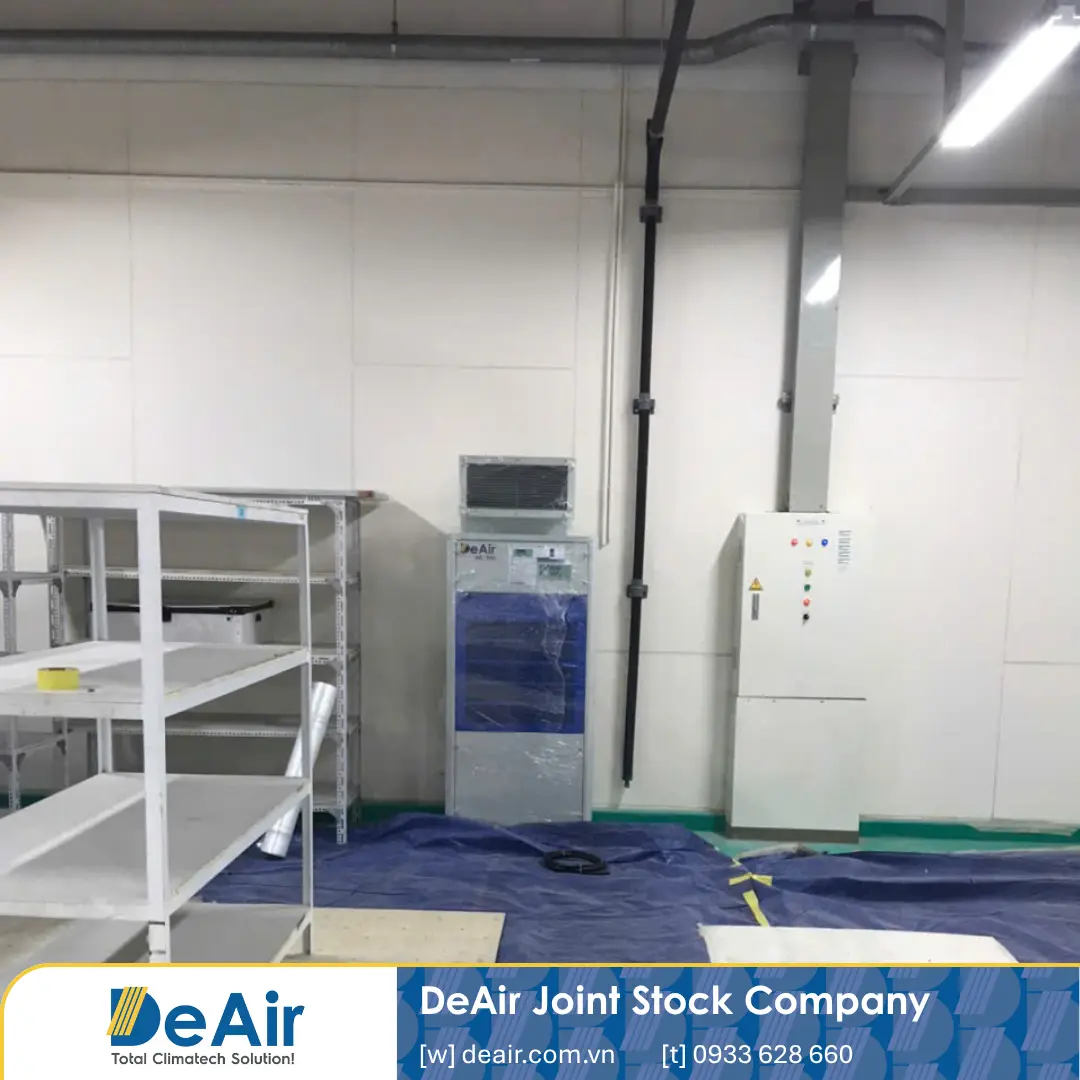
3.3. System Installation & Connection
The machine was placed at the strategically calculated position, ensuring it was level and aesthetically pleasing. Technicians connected the 380V/3-phase power supply, installed the automatic condensate drainage system, and verified the airtightness of all joints.
The DeAir.RE-300 dehumidifier optimally positioned in the raw materials warehouse, ensuring uniform dry air distribution throughout the space.
3.4. Test Run & Calibration
The system underwent synchronized test runs. Engineers measured humidity at multiple points in the warehouse to ensure no localized "dead spots" existed, then calibrated the target setpoint to 35-45% RH and trained the factory staff on system operation.
4. Special Advantage: Support from the Hung Yen Branch
A key factor that gives investors peace of mind when choosing DeAir is our local support network. With a Branch and Warranty Center located in Nhu Quynh, Hung Yen, DeAir commits to:
Ultra-fast support: On-site troubleshooting within 2-4 hours, minimizing warehouse downtime.
Convenient scheduled maintenance: Easy arrangement of bi-annual maintenance without disrupting the production line.
Readily available spare parts: An on-site parts warehouse ensures rapid replacement when necessary.
5. Infographic: Humidity Requirements for Electronic Ceramics Production Stages
📊 HUMIDITY STANDARDS IN ELECTRONIC CERAMICS PRODUCTION & STORAGE
📦
RAW MATERIALS
40-50% RH
Prevents ceramic powder moisture absorption
🏺
GREEN CERAMICS
45-55% RH
Protects structural integrity
✅
FINISHED COMPONENTS
35-45% RH
Meets IPC/JEDEC standards
6. Achieved Results
6.1. Technical & Quality Aspects
Warehouse humidity is stably maintained at 35-45% RH, with temperatures at 20-25°C.
Completely prevents lead oxidation and cracking during the sintering process.
50% electricity cost savings: Thanks to heat-pump technology, reducing the Return on Investment (ROI) period to just 12-18 months.
Stable operation: The system runs continuously 24/7 with high reliability and minimal故障.
Easy management: An intuitive control interface allows factory staff to easily monitor and operate the system.
7. Frequently Asked Questions (FAQ)
Q1: Why are electronic ceramics more sensitive to humidity than other electronic components?
Electronic ceramics have a porous micro-structure that readily absorbs moisture. When humidity infiltrates, it not only causes surface oxidation but also alters the dielectric constant. More critically, during high-temperature sintering, this trapped moisture vaporizes rapidly, creating internal pressure that leads to product cracking (the popcorn effect).
Q2: Is the DeAir.RE-300 dehumidifier suitable for large warehouses?
The DeAir.RE-300 is optimized for small to medium spaces (50-150 m²). For larger warehouses, DeAir will recommend a solution using multiple RE-300 units distributed evenly, or upgrading to higher-capacity models like the DeAir.RE-600 or DeAir.RE-1200 to ensure uniform humidity across the entire area.
Q3: Does DeAir provide scheduled maintenance for factories in Hung Yen?
Yes. This is one of DeAir's greatest strengths. With our warranty center in Nhu Quynh, Hung Yen, we provide bi-annual scheduled maintenance (filter cleaning, refrigerant checks, sensor calibration) with rapid response times, ensuring the system always operates at peak efficiency.
Q4: What is the Return on Investment (ROI) period for a heat-pump dehumidifier?
Thanks to 40-50% energy savings compared to traditional electric resistance drying solutions, combined with the reduction in defective goods caused by moisture, the ROI for the DeAir.RE-300 system is typically achieved within 12 to 18 months. After this period, the enterprise gains net profit from reduced operating costs.
Protect the Quality of Your Electronic Ceramics with Professional Humidity Control Solutions!
Do not let humidity compromise the quality and value of your finished products. Let DeAir provide the most optimal, durable, and energy-efficient solution for your factory.


 DeAir.RE
 DeAir.RE-H
 DeAir.RE-INOX
 DeAir.CRE
 Dezenno
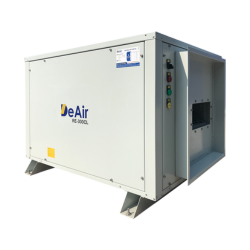 DeAir.RE-CL
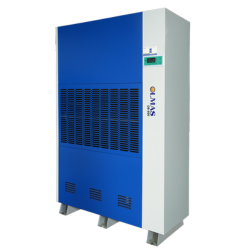 Olmas-OS
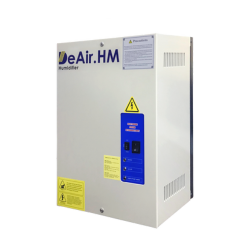 DeAir.HM
 Daxwell
 DeAir.Heat
 AHU
AHU





![[Case Study] DeAir Installs DeAir.De Rotor Humidity Control System for Pharmaceutical Plant in Binh Duong](https://deair.com.vn/thumbs/news/2023_04/ban_giao_may_cho_duoc_bd/[270x153-cr]image1-1024x772.jpg__cv.webp "[Case Study] DeAir Installs DeAir.De Rotor Humidity Control System for Pharmaceutical Plant in Binh Duong")

![[Review & Guide] Olmas OS-300: The New Humidity Control "Warrior" for Medium to Large Warehouses](https://deair.com.vn/thumbs/news/huong_dan_su_dung_may_olmas_21/[270x153-cr]vtm06440.png "[Review & Guide] Olmas OS-300: The New Humidity Control \"Warrior\" for Medium to Large Warehouses")