Context: A rattan and bamboo weaving enterprise in Long Hai required a finished product drying solution for export, meeting strict standards for moisture content, color, and shape.
Challenge: Long Hai's hot, humid coastal climate with salt mist; rattan and bamboo are prone to warping, cracking, and mold if dried improperly.
Solution: Installation of 02 DeAir.RE-600H heat-pump dryers (total capacity 1,200 kg/day), operating in a 15-60°C temperature range.
Result: Evenly dried rattan and bamboo, natural color retention, zero warping, and 50% energy savings compared to traditional electric resistance drying.
1. Unique Challenges of Rattan and Bamboo Drying in Long Hai
1.1. Characteristics of Rattan and Bamboo Materials
Rattan and bamboo are natural materials with a porous, fibrous structure, characterized by uneven moisture absorption and loss. This creates specific technical challenges:
⚠️ TECHNICAL RISKS
Sensitivity to high temperatures: Prone to becoming brittle, cracking, or losing natural color when dried at excessively high temperatures.
Susceptibility to mold and pests: If moisture is not well-controlled during drying and storage.
Warping and deformation: Caused by uneven moisture loss across different parts of the product.
1.2. Long Hai Climate Factors
Long Hai is a coastal region with a specific climate:
High year-round humidity: Averaging 80-85% RH, accompanied by corrosive sea salt mist.
Prolonged rainy season: Makes natural sun-drying difficult, necessitating an active drying solution.
Temperature fluctuations: Affecting the drying and storage processes.
1.3. Finished Product Quality Requirements
Export-grade rattan and bamboo handicrafts demand strict standards:
✅ EXPORT STANDARDS
Uniform moisture content: Typically 10-15% after drying (aligned with rattan/bamboo storage standards of 35-50% RH at 16-32°C).
Natural color retention: No yellowing or fading.
No warping or cracking: A critical factor for handicraft aesthetics and structural integrity.
Mold-free: Ensuring both quality and visual appeal.
2.3. Heat-Pump Technology: The Key to Energy Savings
The heat-pump technology in the DeAir.RE-600H recycles heat from the condensation process to reheat the dehumidified air, delivering superior efficiency:
40-50% energy savings: Compared to traditional electric resistance drying.
Stable performance at lower temperatures: Maintains excellent dehumidification efficiency even in cooler ambient conditions.
Minimal ambient cooling effect: The expelled air is slightly warmed, preventing unwanted temperature drops in the surrounding workspace.
3. Professional Handover and Installation Process
3.1. Site Survey & Solution Consulting
DeAir engineers conducted a detailed on-site survey in Long Hai: assessing drying room dimensions, rattan/bamboo types, required drying capacity, and existing power infrastructure. Based on this, the moisture load was calculated, leading to the recommendation of 02 DeAir.RE-600H units.
3.2. Transportation & Handover
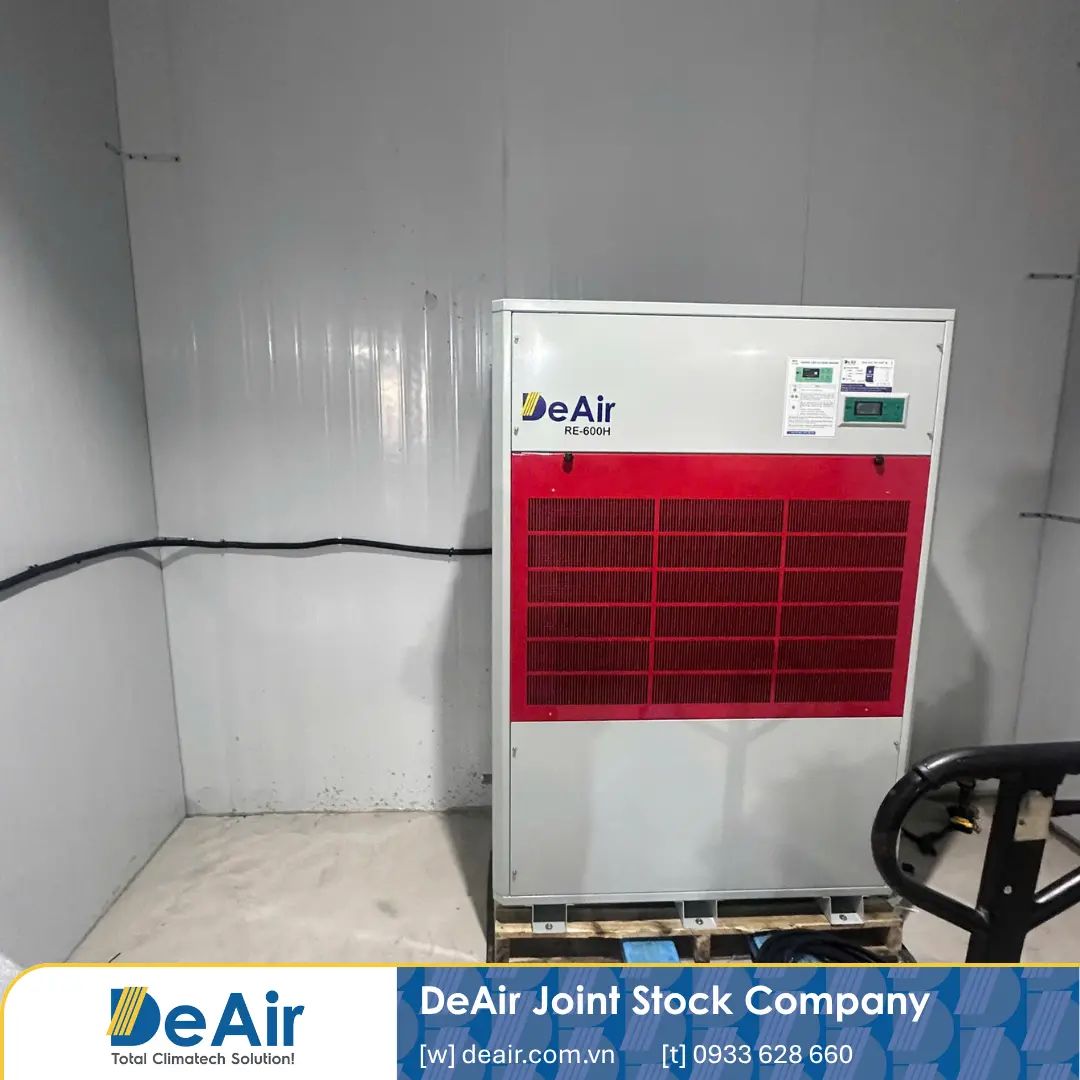
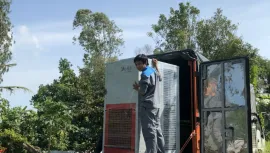
Both units were safely transported from the DeAir factory in Ho Chi Minh City to Long Hai. The handover process included meticulous visual inspections and verification of all accompanying accessories.
The DeAir.RE-600H dryer is safely transported and positioned for installation at the Long Hai rattan and bamboo facility.
3.3. Installation & System Connection
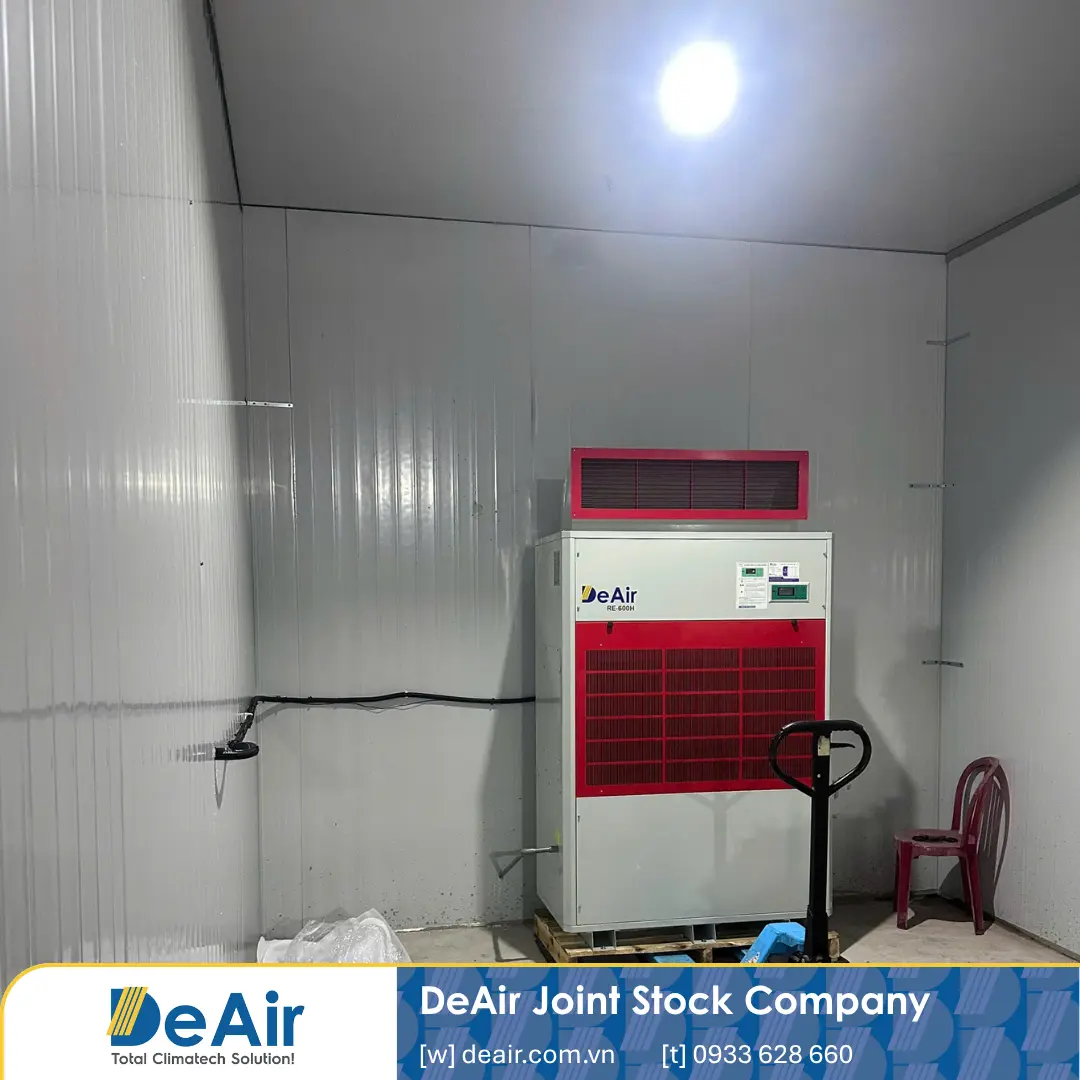
DeAir technicians installed the units, connected the 380V/3-phase power supply, and designed and installed an automatic condensate drainage system (crucial for a 1,200-liter/day capacity). Notably, the ductwork was optimally designed to ensure uniform hot air distribution throughout the drying room.
The ductwork system is professionally installed to ensure uniform distribution of heated air.
3.4. Test Run & Drying Curve Calibration
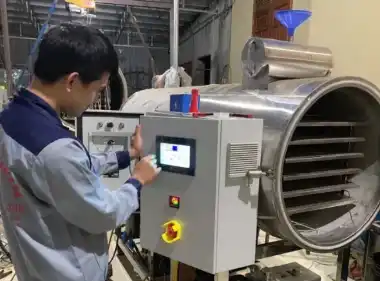
After installation, the system was test-run with actual rattan and bamboo materials. DeAir engineers calibrated the drying curve on the HMI screen: setting the temperature to 45-55°C and adjusting the drying time to suit the specific material types. Facility staff received comprehensive training on system operation and monitoring.
4. Infographic: Traditional Rattan/Bamboo Drying vs. DeAir.RE-600H
📊 COMPARISON: TRADITIONAL DRYING VS. DEAIR.RE-600H
Criteria
Traditional Drying (Electric Resistance / Sun Drying)
DeAir.RE-600H (Heat-Pump)
Drying Time
Long (24-48 hours)
Short (8-12 hours)
Product Quality
Warping, color loss, uneven drying
Even drying, natural color retention
Energy Cost
High (100%)
Reduced by 40-50%
Defect Rate
10-15%
< 2%
Weather Dependency
Yes (sun drying)
No
Control Capability
Manual, imprecise
Automated, precise (±3% RH)
5. Achieved Results
5.1. Technical Performance
Uniform moisture: Rattan and bamboo reach 10-15% moisture content after drying, with no "dead spots".
No warping: Product shape and structural integrity are perfectly maintained.
Natural color retention: No yellowing or fading occurs.
Mold-free: Ensuring top-tier quality and aesthetics.
5.2. Economic Benefits
50% electricity cost savings: Compared to traditional electric resistance drying.
Fast Return on Investment (ROI): Typically achieved within 12-18 months.
Reduced defect rate: Dropped from 10-15% to under 2%, saving significant rework costs.
Increased productivity: Shorter drying cycles allow for more batches per day.
5.3. Product Quality & Environmental Impact
Meets export standards: High-quality products easily access EU, US, and Japanese markets.
Reduced carbon footprint: Heat-pump technology is eco-friendly, aligning with green manufacturing trends.
Weather-independent: Enables year-round, proactive production, even during the rainy season.
6. Frequently Asked Questions (FAQ)
Q1: Why use 02 x RE-600H units instead of 1 larger capacity unit?
Using two units offers multiple advantages: (1) Operational flexibility – you can run 1 or 2 units based on daily volume, (2) System redundancy – if one unit needs maintenance, the other keeps production running, (3) Better heat distribution across the drying room, and (4) Lower total capital expenditure compared to a single high-capacity custom unit.
Q2: Can the heat-pump dryer reach the necessary temperature to dry rattan/bamboo without making it brittle or cracked?
Absolutely. The DeAir.RE-600H operates within a 15-60°C range, perfectly matching the ideal drying temperature for rattan and bamboo (typically 45-55°C). Crucially, its precise temperature and humidity control prevents thermal shock, ensuring even drying without brittleness or cracking. If rapid heating is ever needed, the optional 8.4 kW supplementary heater per unit can be activated.
Q3: Does Long Hai's coastal climate affect the machine's performance?
DeAir carefully factors in coastal climates when designing solutions. The DeAir.RE-600H features a corrosion-resistant powder-coated steel casing and well-protected heat exchangers. Furthermore, the 600 kg/day capacity per unit is more than sufficient to handle the high moisture infiltration load from the marine environment, ensuring stable year-round performance.
Q4: Can DeAir program custom drying curves for different types of rattan and bamboo?
Yes! Equipped with an HMI screen and PLC controller, the DeAir dryer can store multiple "drying curves" tailored to different materials (rattan, bamboo, nứa, trúc, etc.), varying thicknesses, and initial moisture levels. Operators simply select the appropriate profile, and the system automatically adjusts temperature, time, and airflow. DeAir's technical team assists in setting up these profiles during the handover process.
Elevate Your Rattan and Bamboo Product Quality with DeAir's Advanced Drying Solutions!
Do not let humidity and weather compromise the quality of your handicrafts. Let DeAir provide the most optimal, energy-efficient, and eco-friendly drying solution for your facility.
Contact us now for a free site survey and quotation!


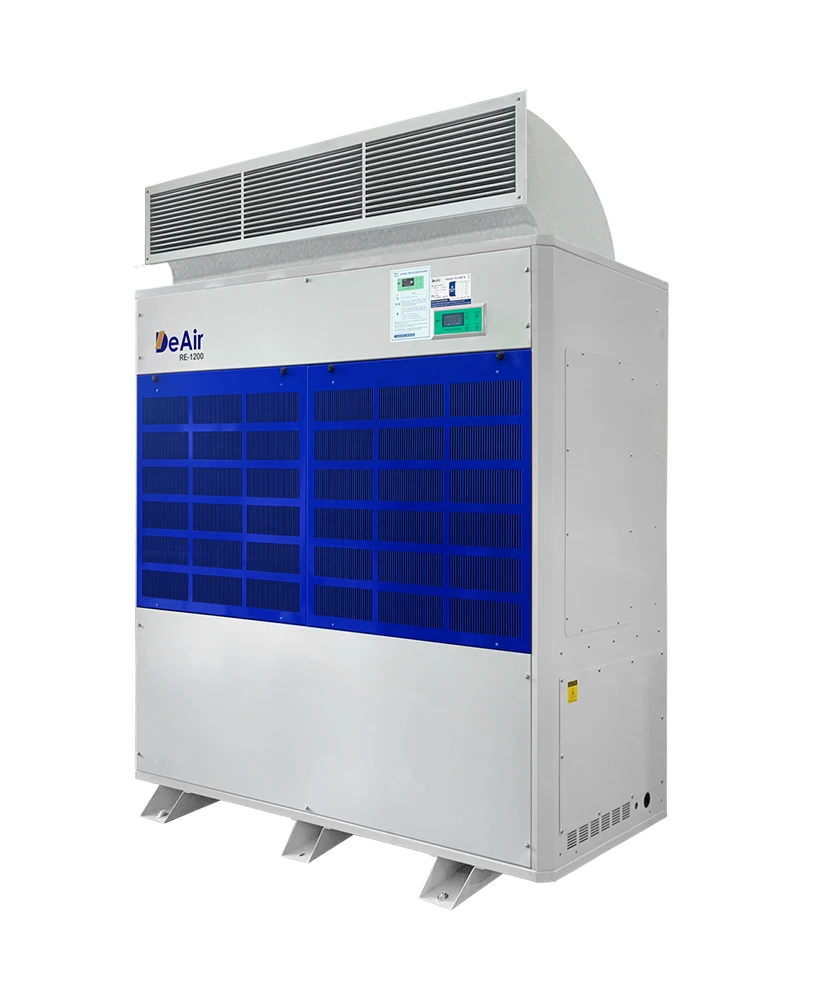 DeAir.RE
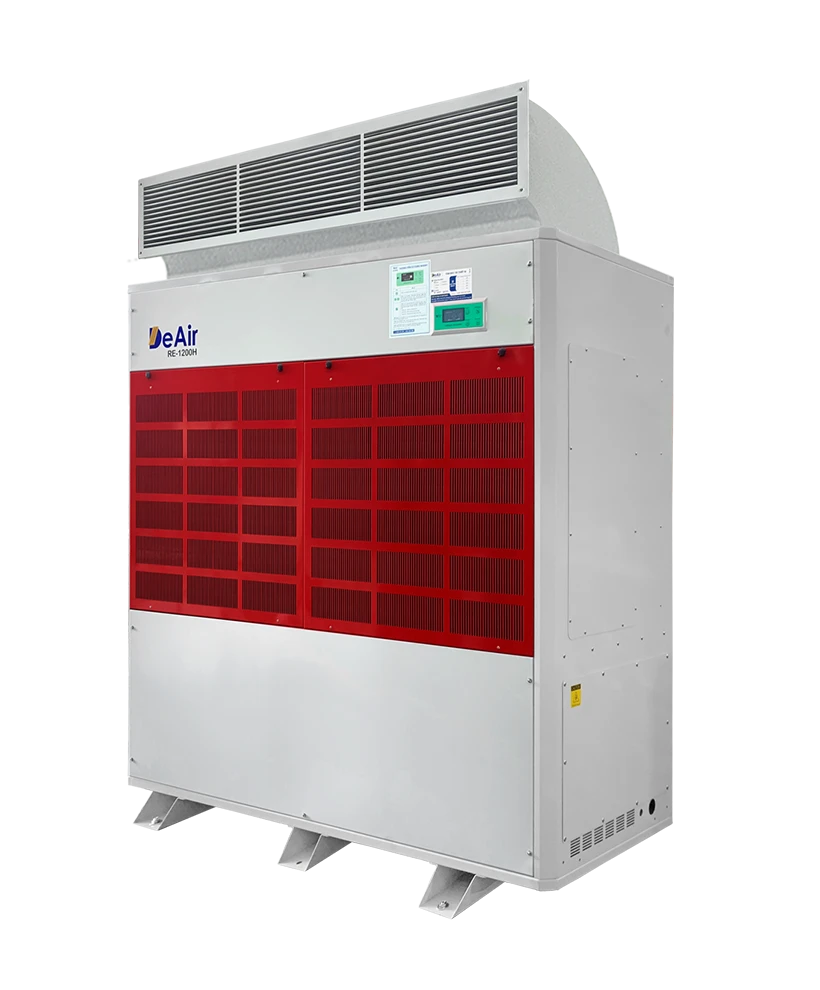 DeAir.RE-H
 DeAir.RE-INOX
 DeAir.CRE
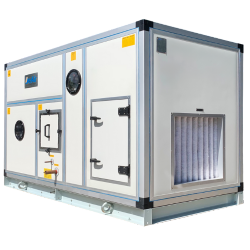 Dezenno
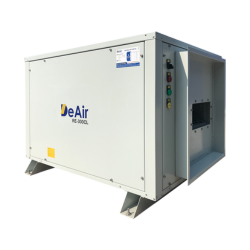 DeAir.RE-CL
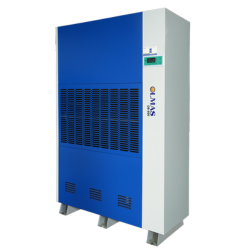 Olmas-OS
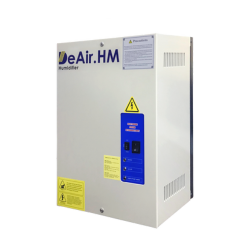 DeAir.HM
 Daxwell
 DeAir.Heat
 AHU
AHU




![[Case Study] DeAir Installs DeAir.De Rotor Humidity Control System for Pharmaceutical Plant in Binh Duong](https://deair.com.vn/thumbs/news/2023_04/ban_giao_may_cho_duoc_bd/[270x153-cr]image1-1024x772.jpg__cv.webp "[Case Study] DeAir Installs DeAir.De Rotor Humidity Control System for Pharmaceutical Plant in Binh Duong")
![[Review & Guide] Olmas OS-300: The New Humidity Control "Warrior" for Medium to Large Warehouses](https://deair.com.vn/thumbs/news/huong_dan_su_dung_may_olmas_21/[270x153-cr]vtm06440.png "[Review & Guide] Olmas OS-300: The New Humidity Control \"Warrior\" for Medium to Large Warehouses")