Context: Cold storage and loading docks in the food industry face severe issues with thick ice buildup and slippery floors due to extreme temperature and humidity differentials.
The Challenge: Frequent door openings allow hot, humid outside air to rush in, causing immediate condensation and icing on floors, doors, and cooling coils.
The Solution: Create a dry air curtain or control humidity across the entire vestibule area using DeAir.CRE isothermal dehumidifiers (available in floor-standing, ceiling-mounted, and stainless steel versions) or high-capacity DeAir.RE-600/RE-1200 models (placed outside the cold room).
The Results: Complete elimination of ice buildup, prevention of workplace accidents, protection of infrastructure, and maintenance of optimal cooling efficiency.
1. The "Nightmare" at Cold Storage: Ice Buildup and Slippery Floors
1.1. The Reality: A "Battle" Between Hot and Cold
In food cold storage facilities (ranging from -18°C to +5°C), doors must open and close continuously as forklifts move goods in and out. Every time a door opens, a massive volume of hot, humid outside air (25-35°C, 70-90% RH) rushes in, meeting the cold surfaces and causing immediate condensation.
⚠️ 4 SEVERE PROBLEMS AT THE LOADING DOCK
❄️
THICK ICE BUILDUP
5-10cm thick ice layers rapidly accumulate on floors, doors, and cooling coils.
⚠️
SLIPPERY FLOORS
High risk of workplace accidents, especially for workers and forklift operators.
🌫️
DENSE FOG
Severely reduced visibility, creating hazardous conditions for operators.
🚪
JAMMED DOORS
Ice buildup on door tracks prevents proper opening/closing, halting operations.
1.2. Severe Consequences: Safety, Efficiency, and Costs
💥 QUANTIFIABLE DAMAGES
Workplace Safety: Slippery floors are the leading cause of accidents in cold storage, leading to severe injuries.
Equipment Efficiency: Ice buildup on cooling coils reduces cooling efficiency by 20-30%, significantly increasing power consumption.
Infrastructure Damage: Jammed doors and deformed tracks lead to costly repairs and replacements.
Product Quality: Temperature fluctuations threaten the integrity of stored frozen goods.
Maintenance Costs: Increased frequency of defrost cycles, cleaning, and repairs causes production disruptions.
2. Technical Solution: Dry Air Curtain & Vestibule Humidity Control
To resolve this issue at its root, DeAir proposes two primary technical strategies, which can be applied individually or in combination depending on the facility's specifics:
🔧 TWO PRIMARY TECHNICAL STRATEGIES
Strategy 1 - Dry Air Curtain: Creates a high-pressure stream of dry air directly at the warehouse door, acting as an "invisible curtain" to block humid outside air from entering.
Strategy 2 - Vestibule Humidity Control: Maintains humidity at 35-45% RH throughout the buffer zone (vestibule) between the cold storage and the outside environment, completely eliminating the conditions required for ice formation.
Comprehensive dehumidification solution for cold storage and loading docks using DeAir industrial dehumidifiers.
3. DeAir Solutions: Diverse Versions for Every Need
DeAir provides a versatile range of dehumidifiers, specifically engineered for the food industry's stringent requirements regarding hygiene, temperature stability, and durability.
3.1. DeAir.CRE Isothermal Dehumidifier - The Optimal Vestibule Solution
The DeAir.CRE isothermal dehumidifier is the "secret weapon" for vestibule areas where workers are present and temperature-sensitive goods are handled.
✨ SUPERIOR ADVANTAGES OF DEAIR.CRE
Humidity control WITHOUT raising temperature: The outlet air temperature remains nearly identical to the inlet, or even 2-3°C lower.
Worker Safety & Comfort: Prevents the stuffy, overheated conditions caused by standard dehumidifiers.
Protection for Temperature-Sensitive Goods: Ideal for transition zones handling frozen or chilled food products.
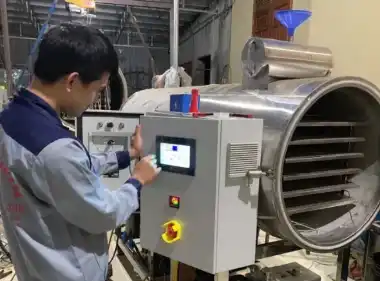
The DeAir.CRE isothermal dehumidifier applied in soft dried mango production—proving its ability to control humidity without affecting product temperature.
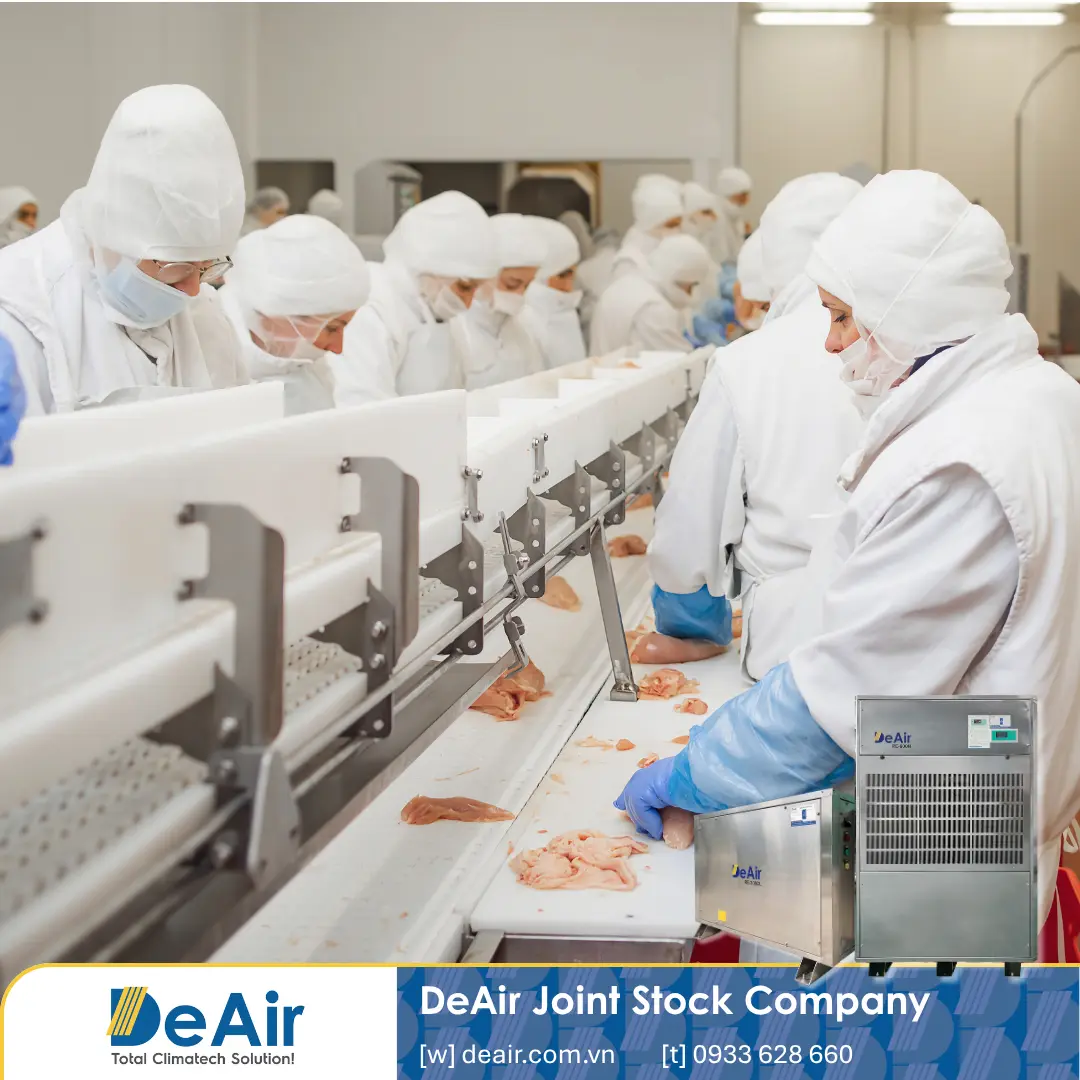
The DeAir.RE heat-pump dehumidifier (RE-600, RE-900, RE-1200) offers massive dehumidification capacities up to 1200 kg/day, perfectly suited for large spaces like expansive loading docks and transit warehouses.
💡 BENEFITS OF OUTDOOR PLACEMENT
Models like the DeAir.RE-600/RE-1200 can be installed outside the cold room, with ducting connected to the target area. This approach:
Preserves valuable indoor cold storage space.
Allows for easy maintenance without disrupting warehouse operations.
Maximizes floor space for forklifts and inventory.
3.3. DeAir.RE-H Stainless Steel Version - The Food Industry Standard
For the food industry, especially seafood and processing, hygiene and corrosion resistance are non-negotiable. The DeAir.RE-H stainless steel heat-pump dehumidifier perfectly meets these stringent standards.
Stainless steel ceiling-mounted DeAir.RE-CL installed in a seafood processing plant—corrosion-resistant and compliant with food safety hygiene standards.
📊 DEAIR PRODUCT SELECTION GUIDE FOR COLD STORAGE
Product Line
Primary Application
Available Versions
When to Choose?
DeAir.CRE (Isothermal)
Vestibule / Buffer Zones
Floor / Ceiling / Stainless Steel / Combo
Strict temperature control needed; workers present.
DeAir.RE (Heat-Pump)
Loading Docks, Large Warehouses
Floor / Ceiling
Large spaces requiring high capacity.
DeAir.RE-H (Stainless Steel)
Food & Seafood Processing
Floor / Ceiling / Stainless Steel
Corrosive environments; high hygiene requirements.
DeAir.RE-CL (Ceiling-Mounted)
Warehouses with limited floor space
Ceiling-Mounted
Need to maximize floor area for operations.
4. Real-World Implementation Process
🔄 DEAIR'S PROFESSIONAL IMPLEMENTATION PROCESS
1
SURVEY & CALCULATION
Measure vestibule volume, door opening frequency, and moisture infiltration load.
→
2
SYSTEM DESIGN
Select model, determine installation location, ducting layout, and sensor placement.
→
3
INSTALLATION & CALIBRATION
Set target to 35-45% RH, calibrate airflow to ensure complete coverage of the door area.
→
4
TRAINING & HANDOVER
Operational training, performance guarantee, and 24-month warranty activation.
5. Achieved Results: The Numbers Speak
5.1. Workplace Safety
90% reduction in slip-and-fall accidents at the loading dock.
Complete elimination of floor ice, ensuring safety for workers and forklifts.
Significantly improved visibility due to the elimination of dense fog.
5.2. Technical Performance
Stable maintenance of 35-45% RH in the vestibule year-round.
Zero fog formation at warehouse doors, drastically improving visibility.
Cooling coils operate stably without icing, maintaining peak cooling efficiency.
Warehouse doors operate smoothly without jamming from ice buildup.
5.3. Economic Impact
20-30% reduction in cooling electricity costs due to ice-free, highly efficient cooling coils.
80% reduction in maintenance and defrosting costs.
Extended lifespan of cold storage equipment, reducing replacement costs.
Minimized operational downtime caused by ice-related malfunctions.
6. Infographic: Before & After Comparison
📊 COLD STORAGE: BEFORE & AFTER DEAIR IMPLEMENTATION
Criteria
Before Installation
After DeAir Installation
Floor Condition
5-10cm thick ice, highly slippery
100% dry and safe
Cooling Coil Icing
Thick ice, 20-30% efficiency drop
Ice-free, optimal efficiency
Doorway Fog
Dense, severely reducing visibility
Completely clear
Slip-and-Fall Incidents
Frequent and high risk
Reduced by 90%
Warehouse Door Status
Frequently jammed
Smooth operation
Cooling Electricity Costs
High (due to inefficient coils)
Reduced by 20-30%
Maintenance & Defrost Costs
High and frequent
Reduced by 80%
7. Frequently Asked Questions (FAQ)
Q1: How is the DeAir.CRE isothermal dehumidifier different from standard models?
The DeAir.CRE controls humidity WITHOUT raising the ambient temperature. The outlet air temperature remains nearly identical to the inlet, or even 2-3°C lower. This is a crucial difference from standard dehumidifiers (which typically raise temperatures by 5-10°C), making it ideal for areas with workers and temperature-sensitive goods.
Q2: Can the dehumidifier be installed outside the cold room?
Yes! Models like the DeAir.RE-600 and DeAir.RE-1200 can be placed outside the cold room, with ducting connected to the target area. This saves valuable indoor space, simplifies maintenance, and prevents any disruption to warehouse operations.
Q3: What is the target humidity level for a loading dock vestibule?
Based on DeAir's extensive field experience, the target humidity for a vestibule should be maintained at 35-45% RH. This level is low enough to completely prevent ice formation, yet not so dry as to cause discomfort for workers.
Q4: Will the system affect the temperature inside the cold storage?
No. DeAir's solution is designed to treat the humidity in the vestibule (the buffer zone between the cold storage and the outside). The equipment is not placed directly inside the cold storage, so it does not interfere with the food preservation temperature.
Q5: Are the operating costs of the machine high?
Thanks to advanced Heat-Pump technology, DeAir dehumidifiers save up to 40% on electricity compared to standard models. Furthermore, this operating cost is fully offset by the 20-30% reduction in cooling electricity and the 80% reduction in maintenance and defrosting costs.
Q6: Should I choose a floor-standing or ceiling-mounted version?
Floor-standing models are ideal for spacious areas requiring mobility. Ceiling-mounted versions (DeAir.RE-CL, DeAir.CRE-CL) are optimal when floor space is limited and needs to be preserved for forklifts and inventory. DeAir will survey your site and recommend the most suitable version.
Q7: When should I choose the stainless steel version?
The stainless steel versions (DeAir.RE-H, DeAir.CRE-H) are highly recommended for the food, seafood, and pharmaceutical industries—environments that demand high hygiene standards, resistance to corrosion, or frequent chemical cleaning. The 304 stainless steel casing is corrosion-resistant, easy to clean, and meets food safety standards.
Don't Let Ice Buildup and Slippery Floors Endanger Your Staff and Inventory!
DeAir's specialized dehumidification solutions—featuring DeAir.CRE isothermal models, DeAir.RE heat-pump models, and food-grade stainless steel versions—are the key to protecting workplace safety, maintaining cold storage efficiency, and optimizing operational costs.
Contact DeAir today for a site survey and customized solution!


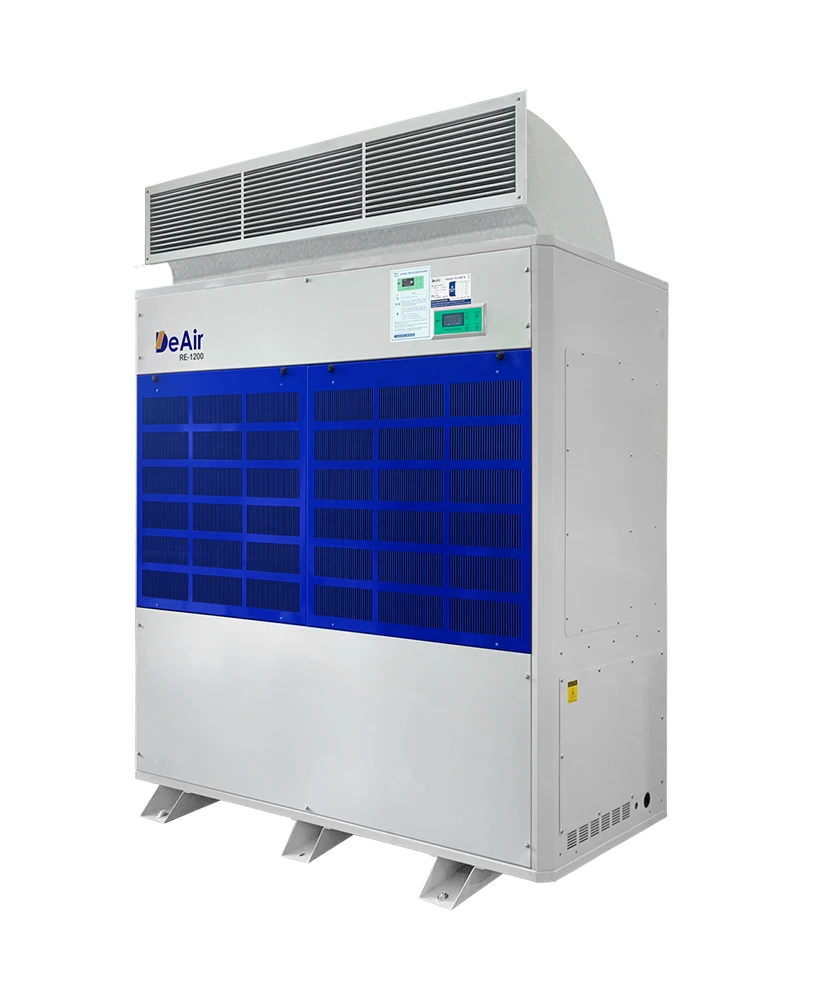 DeAir.RE
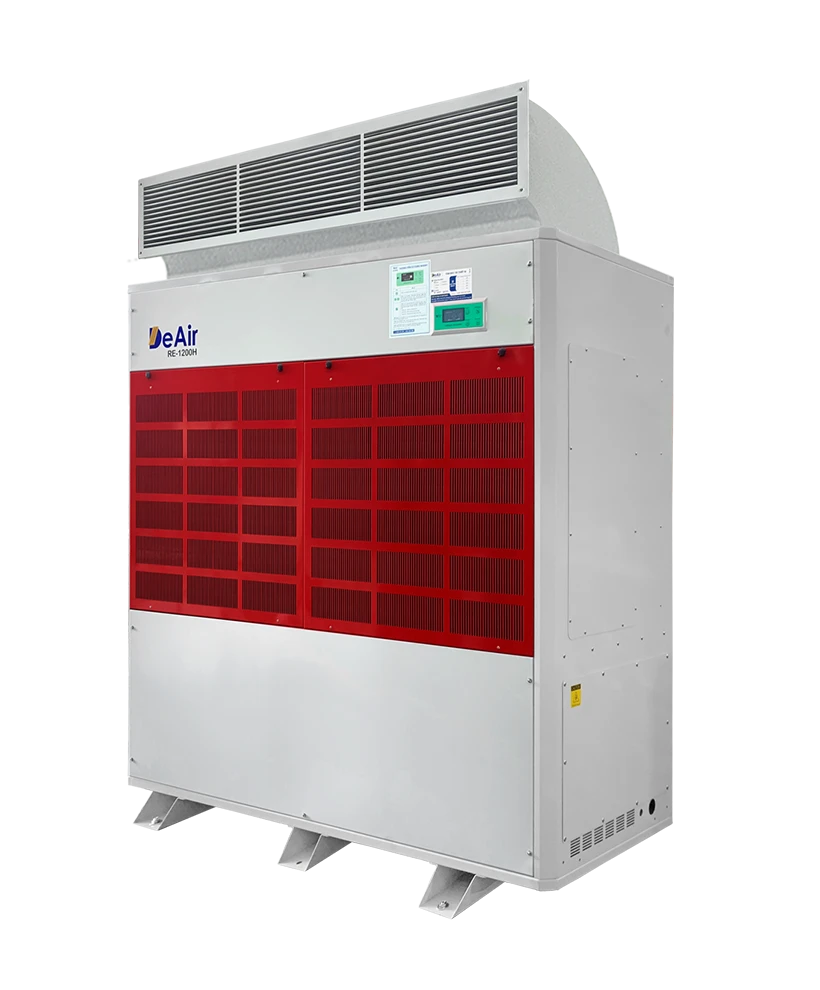 DeAir.RE-H
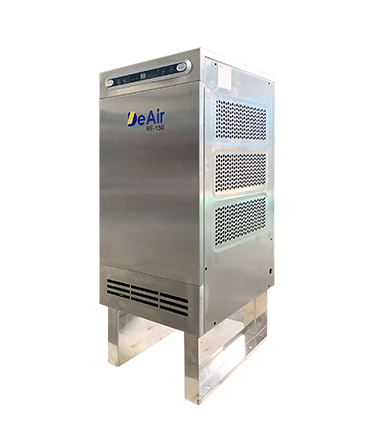 DeAir.RE-INOX
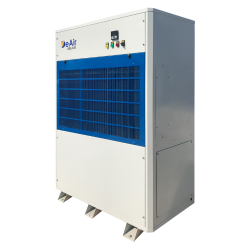 DeAir.CRE
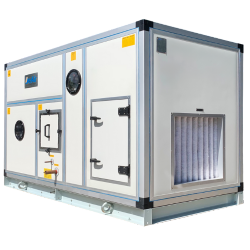 Dezenno
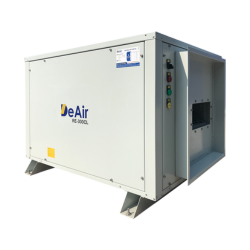 DeAir.RE-CL
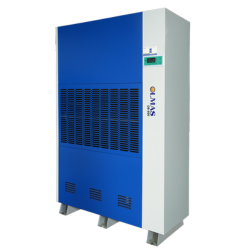 Olmas-OS
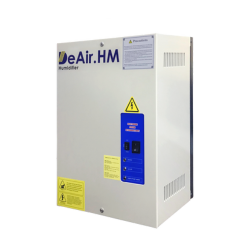 DeAir.HM
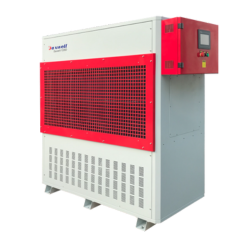 Daxwell
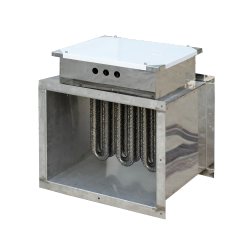 DeAir.Heat
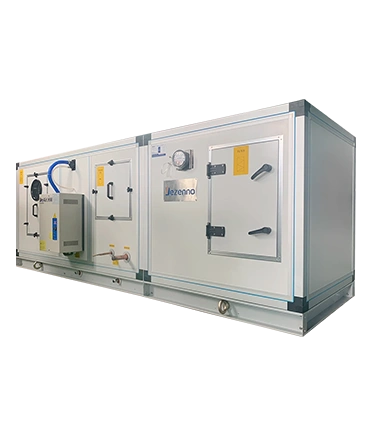 AHU
AHU








![[Case Study] DeAir Installs DeAir.De Rotor Humidity Control System for Pharmaceutical Plant in Binh Duong](https://deair.com.vn/thumbs/news/2023_04/ban_giao_may_cho_duoc_bd/[270x153-cr]image1-1024x772.jpg__cv.webp "[Case Study] DeAir Installs DeAir.De Rotor Humidity Control System for Pharmaceutical Plant in Binh Duong")

![[Review & Guide] Olmas OS-300: The New Humidity Control "Warrior" for Medium to Large Warehouses](https://deair.com.vn/thumbs/news/huong_dan_su_dung_may_olmas_21/[270x153-cr]vtm06440.png "[Review & Guide] Olmas OS-300: The New Humidity Control \"Warrior\" for Medium to Large Warehouses")